Filing a case in India involves more than simply going to a court and submitting a complaint. The correct process depends on what happened, what legal remedy is required, which law applies, which court or authority has jurisdiction and whether the matter is civil, criminal or covered by a specialised law.
A civil dispute may involve property, money, contracts, family matters or other private rights. A criminal matter concerns an alleged offence and follows the criminal procedure prescribed by law. Some disputes are handled by specialised forums such as consumer commissions, family courts, commercial courts, tribunals or other statutory authorities.
For civil suits, the Code of Civil Procedure, 1908 (CPC) provides a general procedural framework. It states that suits are generally instituted by presenting a plaint to the appropriate court, subject to the requirements of the Code and applicable laws.
India also has an official e-Filing system through which civil and criminal cases and applications can be filed before courts that have adopted the system.
How to File a Case in India: Quick Process
| Step | What You Need to Do |
| 1 | Identify the legal problem |
| 2 | Determine whether it is civil, criminal or a specialised matter |
| 3 | Identify the applicable law |
| 4 | Check limitation and other deadlines |
| 5 | Identify the court or authority with jurisdiction |
| 6 | Collect documents and evidence |
| 7 | Consult a lawyer where appropriate |
| 8 | Prepare the plaint, complaint, petition or other required document |
| 9 | Pay applicable court fees or filing charges |
| 10 | File physically or through e-Filing where available |
| 11 | Correct filing defects, if the registry raises objections |
| 12 | Obtain the case number and track the proceedings |
| 13 | Attend hearings and comply with court directions |
| 14 | Follow the case through judgment, order and any appeal/execution |
Step 1: Identify What Legal Problem You Have
Before filing anything, clearly identify what has happened.
For example:
- Someone has not repaid your money.
- You have a property dispute.
- A contract has been breached.
- You have suffered an alleged offence.
- You want a divorce or another family-law remedy.
- A consumer dispute has arisen.
- You want an injunction to prevent a particular action.
- You want compensation for a legally recognised claim.
The remedy you need determines the type of proceeding.
For example, a property ownership dispute may require a civil proceeding, while theft may require the criminal process.
Some matters may involve more than one legal remedy.
Step 2: Determine Whether the Matter Is Civil or Criminal
This is one of the most important steps.
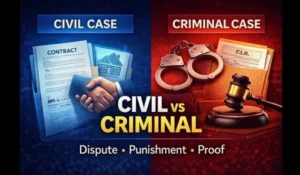
Civil Case
A civil case generally concerns private rights and obligations.
Examples include:
- Property disputes
- Money recovery
- Contract disputes
- Certain family disputes
- Possession disputes
- Injunction matters
- Commercial disputes
A civil proceeding may seek remedies such as damages, recovery, declaration, possession or injunction.
Criminal Case
A criminal case concerns an alleged offence under applicable criminal law.
Examples can include:
- Theft
- Assault
- Robbery
- Criminal intimidation
- Certain cheating offences
- Forgery-related offences
- Homicide
- Sexual offences
India’s current general criminal-law framework includes the Bharatiya Nyaya Sanhita, 2023 (BNS) and the Bharatiya Nagarik Suraksha Sanhita, 2023 (BNSS), along with the Bharatiya Sakshya Adhiniyam, 2023 dealing with evidence.
The correct procedure can differ depending on the offence and whether the matter begins through the police or a complaint before a Magistrate.
Step 3: Identify the Correct Law
The next step is to determine which law applies.
Different disputes may be governed by different legislation.
For example:
| Problem | Possible Legal Framework |
| Contract dispute | Indian Contract Act and other applicable laws |
| Property dispute | Transfer of Property Act, state land laws and other applicable laws |
| Civil procedure | Code of Civil Procedure, 1908 |
| Criminal offence | BNS and applicable special criminal laws |
| Criminal procedure | BNSS and applicable special laws |
| Consumer dispute | Consumer Protection Act, 2019 |
| Company dispute | Companies Act, 2013 and applicable rules |
| Family matter | Relevant personal/family law and procedural legislation |
| Employment dispute | Applicable labour and employment laws |
| Commercial dispute | Commercial Courts Act and other applicable laws |
The table is only a general guide. A dispute can be governed by several laws simultaneously.
Step 4: Check the Limitation Period
Before filing a case, check whether any limitation period applies.
Limitation means that the law may prescribe a particular period within which a legal proceeding must be instituted.
The applicable period depends on the type of claim and the law governing it.
For example, limitation rules can differ for:
- Money recovery
- Property claims
- Contract disputes
- Appeals
- Applications
- Other legal proceedings
The Limitation Act, 1963 contains limitation provisions for many civil proceedings, but special laws can prescribe different periods.
Do not wait until the last day to determine limitation. The date when the cause of action arose, acknowledgment, continuing causes of action and other legally relevant circumstances can affect the calculation.
Step 5: Identify the Correct Court or Forum
You cannot normally file every case in any court you choose.
The appropriate court depends on factors such as:
- Territorial jurisdiction
- Subject-matter jurisdiction
- Pecuniary jurisdiction where applicable
- Nature of the dispute
- Value of the claim
- Location of the parties
- Location of property
- Where the cause of action arose
- Special statutory requirements
For civil suits, the CPC contains provisions concerning jurisdiction and the place where suits may be instituted. For example, Section 16 deals with certain suits concerning immovable property, while Section 20 addresses other suits based on factors such as where defendants reside or where the cause of action arises.
Special Courts and Forums
Some matters are handled by specialised institutions rather than an ordinary civil court.
Examples include:
- Consumer Commissions
- Family Courts
- Commercial Courts
- National Company Law Tribunal
- Debt Recovery Tribunals
- Labour and industrial forums
- Various statutory tribunals
Therefore, identifying the correct forum is an important part of the filing process.
Step 6: Collect Documents and Evidence
Gather all relevant material before preparing the case.
Depending on the dispute, this may include:
- Identity documents
- Contracts and agreements
- Sale deeds
- Property documents
- Invoices
- Bank statements
- Payment receipts
- Emails
- Letters
- WhatsApp or other electronic communications
- Photographs
- Videos
- Medical records
- Police documents
- Witness details
- Notices and replies
- Previous court orders
Keep the original documents safely and prepare copies or electronic versions as required.
Do not delete potentially relevant electronic communications after a dispute arises.
Step 7: Prepare a Clear Chronology
Before drafting the case, prepare a timeline.
For example:
| Date | Event |
| 5 January | Agreement signed |
| 20 January | Payment made |
| 10 February | Goods/services due |
| 15 February | Default occurred |
| 20 February | Notice sent |
| 5 March | Reply received |
| 10 March | Dispute remained unresolved |
A chronology helps the lawyer understand the dispute and makes it easier to prepare pleadings.
Step 8: Consult a Lawyer
A lawyer is not necessarily required for every interaction with a government authority or every legal process, but professional legal advice can be particularly important when filing a court case.
A lawyer can help with:
- Identifying the correct legal remedy
- Checking limitation
- Determining jurisdiction
- Drafting pleadings
- Identifying necessary parties
- Preparing evidence
- Court fees
- Filing requirements
- Responding to objections
- Court appearances
- Appeals and execution
For complicated property, criminal, commercial, family or high-value matters, obtaining legal advice before filing can help avoid procedural mistakes.
Step 9: Draft the Correct Legal Document
The document you file depends on the type of proceeding.
Civil Suit
A civil suit is generally instituted through a plaint. Order IV of the CPC provides that a suit is commenced by presenting the plaint to the court or authorised officer, subject to the Code’s requirements.
A plaint generally sets out matters such as:
- Name and details of the parties
- Relevant facts
- Cause of action
- Jurisdiction
- Relief sought
- Valuation where applicable
- Court-fee details where required
Criminal Matter
A criminal matter can begin through different routes depending on the circumstances.
For example, information concerning a suspected offence may be provided to the police where the law provides for police investigation. In other circumstances, a complaint may be presented before the appropriate Magistrate.
The BNSS contains provisions governing criminal procedure, including complaint cases and interaction between complaint proceedings and police investigations.
Petition or Application
Some matters require a petition or application rather than a traditional civil plaint.
The exact document depends on the remedy and forum.
Step 10: Calculate and Pay Court Fees
Civil proceedings can involve court fees, which vary according to the nature and valuation of the case and the applicable state law.
Other expenses can include:
- Process fees
- Documentation charges
- Typing or printing
- Notarial services where required
- Advocate fees
- Certified-copy charges
- Other case-specific expenses
There is no single court-fee amount applicable to every case in India.
Before filing, check the applicable state court-fee law, court rules and filing requirements.
Step 11: File the Case
A case can generally be filed through the applicable court filing mechanism.
Physical Filing
Where required, the documents can be submitted at the filing counter or registry of the appropriate court.
The registry examines the filing for procedural requirements.
Online Filing
The official e-Filing system enables litigants and advocates to electronically file cases and applications in courts that have adopted the system.
The platform supports functions such as:
- Uploading pleadings
- Uploading documents in PDF form
- e-Signing
- Online court-fee payment where integrated
- Vakalat submission
- Case tracking
- Portfolio management
Both civil and criminal matters can be filed through the e-Filing system before participating High Courts, District Courts and other covered courts.
The exact availability and filing procedure can vary by court.
Step 12: Filing Scrutiny and Objections
Filing a document does not necessarily mean that the case is immediately registered.
The court registry may examine the filing for defects.
Possible issues can include:
- Missing documents
- Incorrect formatting
- Incomplete information
- Insufficient court fee
- Improper signatures
- Missing authorisation
- Incorrect party details
- Other procedural defects
If objections are raised, they generally need to be corrected within the applicable process and time.
Once the filing satisfies the requirements, the case can be registered according to the applicable court procedure.
Step 13: Get the Case Number
After registration, the case receives identifying information such as a case number or filing/registration number.
Keep a record of:
- Case number
- Court name
- Case type
- Filing date
- Registration date
- Party names
- Lawyer’s details
- Next hearing date
The e-Courts system provides online case-related services, while the specific information available depends on the court and case.
Step 14: Serve Notice on the Other Party
In a civil case, the defendant generally needs to be served with the court’s process and the relevant documents.
The court may issue summons or other directions according to the applicable procedure.
In criminal proceedings, notice, summons, warrant or other process may be issued depending on the nature and stage of the case.
Do not assume that simply filing a case means the other party has automatically been legally served.
Step 15: Attend Court Hearings
After filing, the case can involve multiple stages.
Depending on the type of matter, these can include:
- Preliminary hearings
- Appearance of parties
- Filing of responses
- Interim applications
- Framing of issues or charges
- Evidence
- Cross-examination
- Arguments
- Judgment
Your lawyer or the court’s directions will determine when your personal presence is required.
Step 16: Follow Court Orders and Deadlines
Once a case is filed, parties must comply with court directions.
These can include:
- Filing documents
- Filing replies
- Producing evidence
- Paying required fees
- Appearing on specified dates
- Responding to applications
- Complying with interim orders
Ignoring court directions can adversely affect the proceeding.
Step 17: Judgment and Further Remedies
A case eventually results in a judgment, order or other legally recognised outcome.
Depending on the case, a party may have a right to:
- Appeal
- Revision
- Review
- Seek execution
- Apply for modification or other relief where permitted
The available remedy and limitation period depend on the type of order and applicable law.
How to File a Criminal Case in India
The phrase “file a criminal case” can refer to different procedures.
Option 1: Approach the Police
If you believe a cognisable offence has occurred, information can be provided to the police according to the applicable criminal procedure.
The police may investigate the matter in accordance with law.
Option 2: Approach a Magistrate
In appropriate circumstances, a person can make a complaint before the competent Magistrate.
The Magistrate can deal with the complaint according to the applicable provisions of the BNSS.
The correct route depends on the facts and the nature of the alleged offence.
Important Point
A private disagreement should not automatically be presented as a criminal offence merely because the parties have a dispute.
The facts must satisfy the legal requirements of the relevant offence.
How to File a Civil Case in India
A typical civil filing process is:
- Identify the civil right or legal claim.
- Check limitation.
- Determine the correct court.
- Identify all necessary parties.
- Collect documents.
- Calculate the appropriate valuation and court fee.
- Prepare the plaint.
- Sign and verify the pleadings as required.
- Attach supporting documents.
- File physically or through e-Filing where available.
- Address registry objections.
- Obtain registration/case number.
- Complete service of process.
- Attend subsequent proceedings.
Under the CPC, the institution of a suit is linked to presentation of the plaint before the appropriate court or authorised officer.
Documents Required to File a Case
There is no universal document list for every case.
Common documents may include:
- Identity and address proof
- Agreements
- Receipts
- Bank records
- Property documents
- Invoices
- Notices
- Replies
- Photographs
- Electronic communications
- Medical documents, where relevant
- Police documents, where relevant
- Previous judgments or orders
- Documents supporting the relief claimed
The required documents depend on the case.
How Much Does It Cost to File a Case in India?
There is no single filing cost for all cases.
The total cost can include:
| Expense | Depends On |
| Court fee | Nature and valuation of case and applicable state law |
| Advocate fee | Lawyer, case complexity, court and stage |
| Process fee | Applicable court rules |
| Documentation | Number and type of documents |
| Certified copies | Number and type of copies |
| Expert fees | Whether expert evidence is required |
| Travel | Location and number of hearings |
| Other charges | Case-specific requirements |
A lawyer’s professional fee is separate from the statutory court fee.
Can You File a Case Without a Lawyer?
In some situations, a person may represent themselves, subject to the rules applicable to the court and proceeding.
However, representing yourself can be difficult when the matter involves:
- Complex procedural rules
- Multiple legal issues
- High-value property
- Serious criminal allegations
- Commercial disputes
- Detailed evidence
- Appeals
- Constitutional or specialised proceedings
Before deciding to appear personally, understand the procedural requirements of the particular forum.
Free Legal Aid in India
People who meet the eligibility requirements can obtain free legal services through the legal-services system.
NALSA states that legal aid can include representation by an advocate, preparation of pleadings, payment of certain process expenses and other legal services in appropriate cases.
Under Section 12 of the Legal Services Authorities Act, eligible categories include, among others, women and children, members of Scheduled Castes or Scheduled Tribes, persons with disabilities, persons in custody, industrial workmen and certain persons meeting the applicable income criteria.
A person can approach the appropriate:
- Taluk Legal Services Committee
- District Legal Services Authority
- State Legal Services Authority
- High Court Legal Services Committee
- Supreme Court Legal Services Committee
depending on the matter and level of court.
For example, the Delhi State Legal Services Authority lists free legal-aid eligibility and services for qualifying persons in Delhi.
Common Mistakes When Filing a Case
- Filing in the Wrong Court
Jurisdiction should be checked before filing.
- Missing the Limitation Period
A valid claim can face serious procedural problems if filed after the applicable limitation period.
- Filing Without Evidence
A legal claim should be supported by relevant documents and other admissible evidence.
- Naming the Wrong Parties
All necessary and proper parties should be identified carefully.
- Asking for the Wrong Relief
The relief requested should match the legal rights and remedy available under the applicable law.
- Ignoring Court Fees
Insufficient court fee can create filing objections or other procedural problems.
- Treating Every Dispute as Criminal
A contractual or financial disagreement does not automatically constitute a criminal offence.
- Ignoring Notices and Court Directions
Failure to respond within the required period can affect your case.
- Giving Inconsistent Facts
Statements in complaints, notices, pleadings and evidence should be factually accurate and consistent.
- Waiting Too Long
Legal deadlines can be important. Obtain advice promptly when a dispute arises.
Civil Case vs Criminal Case: Filing Difference
| Point | Civil Case | Criminal Case |
| Main purpose | Obtain a civil remedy | Address an alleged offence |
| Typical starting document | Plaint, petition or application | Police information/FIR or complaint, depending on circumstances |
| Typical parties | Plaintiff and defendant | Prosecution/State and accused |
| Court | Appropriate civil/specialised court | Appropriate criminal court |
| Main remedy | Damages, injunction, declaration, recovery etc. | Conviction/acquittal and punishment where applicable |
| Procedure | Mainly CPC plus applicable special laws | Mainly BNSS plus applicable special laws |
| Evidence | Depends on proceeding and applicable evidence law | Bharatiya Sakshya Adhiniyam and applicable special laws |
| Lawyer | May be advisable depending on complexity | Particularly important in serious criminal matters |
Case Filing Checklist
Before filing a case, check:
- What exactly happened?
- What legal right or offence is involved?
- Which law applies?
- Is the matter civil, criminal or specialised?
- What remedy do you want?
- Is the claim within limitation?
- Which court has jurisdiction?
- Who are the correct parties?
- What documents do you have?
- Do you have relevant electronic evidence?
- Is a legal notice required or useful?
- What court fee applies?
- Have the pleadings been correctly drafted?
- Can the case be filed online?
- Do you qualify for free legal aid?
- What deadlines must be followed after filing?
FAQs
Can anyone file a case in India?
A person can initiate legal proceedings when they have a legally recognised basis and satisfy the applicable procedural requirements. The appropriate procedure depends on the type of matter.
Can I file a case online?
Yes, e-Filing is available for courts that have adopted the system. The official e-Filing platform supports filing of civil and criminal cases and applications in participating courts.
How long does it take to file a case?
The filing itself can sometimes be completed relatively quickly, but registration may depend on document completeness, registry scrutiny and objections. The entire case can take much longer, depending on its nature and court.
Can I file a case without a lawyer?
In some proceedings, self-representation may be possible. However, the applicable court rules and nature of the matter should be considered before choosing this approach.
What happens after filing a civil case?
The filing may be scrutinised, defects may need correction, the case may be registered, and the court can issue process to the opposing party. Subsequent stages depend on the nature of the case.
What happens after filing a criminal complaint?
The next step depends on whether the matter is being investigated by police or is proceeding as a complaint case before a Magistrate. The BNSS provides different procedures for different situations.
What if I cannot afford a lawyer?
Eligible persons can apply for free legal services through the Legal Services Authorities. NALSA provides legal aid for both civil and criminal matters to persons meeting the statutory eligibility requirements.
Is a legal notice necessary before filing every case?
No. Whether a notice is required depends on the type of claim, the parties involved and the applicable law. Certain statutes and situations have specific notice requirements.
Conclusion
Filing a case in India starts with identifying the correct legal remedy, not simply submitting paperwork to a court. The first steps are to understand the dispute, identify the applicable law, check limitation, determine jurisdiction and collect supporting evidence.
For a civil matter, the proceeding may generally involve a plaint, court-fee requirements, filing scrutiny, service of process, evidence and judgment. For a criminal matter, the route may involve the police or a Magistrate depending on the offence and circumstances.
India’s official e-Filing system also allows eligible civil and criminal filings to be submitted online in courts that have adopted the system.
Because filing requirements can vary significantly by court, state, subject matter and type of proceeding, it is important to check the current rules applicable to the particular case. Where the matter is complex or legally significant, professional legal advice can help determine the appropriate forum, documents, limitation period and remedy.