A civil case and a criminal case are two different types of legal proceedings in India. Although both are decided by courts, they serve different purposes, involve different procedures and can lead to different outcomes.
A civil case generally concerns disputes involving private rights, property, contracts, money, family matters or other legal obligations. A criminal case concerns an alleged offence and the criminal liability of the accused.
India’s current criminal-law framework includes the Bharatiya Nyaya Sanhita, 2023 (BNS), which deals with offences, and the Bharatiya Nagarik Suraksha Sanhita, 2023 (BNSS), which contains the main procedural framework for criminal matters. The Bharatiya Sakshya Adhiniyam, 2023 deals with the law of evidence. These laws replaced the earlier core criminal-law statutes from their commencement in 2024.
For civil proceedings, the Code of Civil Procedure, 1908 (CPC) provides a major procedural framework. Section 9 of the CPC establishes the general jurisdiction of civil courts over suits of a civil nature unless their jurisdiction is expressly or impliedly barred.
Civil Case vs Criminal Case: Quick Comparison
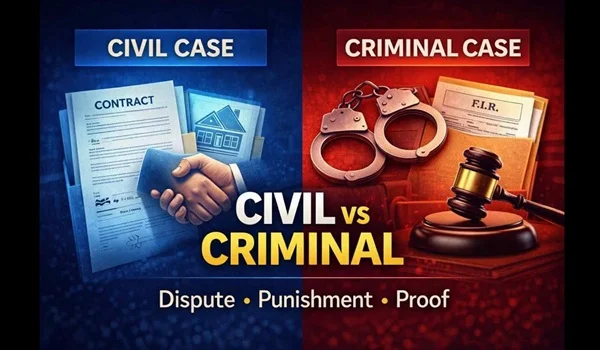
| Basis | Civil Case | Criminal Case |
| Main purpose | Resolve private disputes and provide appropriate civil remedies | Determine criminal liability for an alleged offence |
| Typical parties | Plaintiff and defendant | State/prosecution and accused |
| Main subject | Property, contracts, money, family matters, rights, compensation, etc. | Offences such as theft, assault, robbery and other acts prohibited by criminal law |
| Who usually initiates it? | Person or entity claiming a civil right or remedy | Criminal process may begin through information to police, a complaint or another procedure recognised by law |
| Main objective | Compensation, recovery, declaration, injunction or enforcement of rights | Conviction and punishment where guilt is established |
| Standard of proof | Generally preponderance of probabilities | Generally beyond reasonable doubt |
| Possible result | Decree, judgment, injunction, damages, recovery or other civil relief | Conviction or acquittal |
| Imprisonment | Not ordinarily the remedy in a normal civil suit | May be imposed where the applicable offence provides for it |
| Main procedural framework | Code of Civil Procedure, 1908, subject to specialised laws | Bharatiya Nagarik Suraksha Sanhita, 2023, along with applicable special laws |
| Evidence | Evidence rules applicable to the proceeding | Bharatiya Sakshya Adhiniyam, 2023 and applicable special laws |
What Is a Civil Case?
A civil case is a legal proceeding generally used to resolve a dispute concerning civil rights or obligations.
The dispute may involve two individuals, a company and an individual, two businesses, a landlord and tenant, family members or other parties.
Common Examples of Civil Cases
Civil proceedings can involve:
- Property ownership disputes
- Possession disputes
- Contractual disputes
- Recovery of money
- Breach of contract
- Partnership disputes
- Certain family and matrimonial matters
- Inheritance and succession disputes
- Landlord-tenant disputes
- Compensation claims
- Injunction applications
- Commercial disputes
For example, suppose A sells goods to B under a contract, but B does not pay the agreed amount. Depending on the circumstances and applicable law, A may pursue a civil or commercial remedy to recover the money.
The CPC contains provisions dealing with matters such as jurisdiction, institution of suits and the procedure followed in civil courts.
What Is a Criminal Case?
A criminal case concerns an alleged act or omission that is defined as an offence under applicable criminal law.
The purpose is not simply to resolve a private disagreement. It is to determine whether the accused has committed an offence and, if guilt is established, apply the punishment or other consequence prescribed by law.
The BNS is the principal general statute dealing with offences under the current criminal-law framework. It describes itself as an Act to consolidate and amend provisions relating to offences and connected matters.
Examples of Criminal Cases
Criminal matters may involve allegations such as:
- Theft
- Robbery
- Assault
- Criminal intimidation
- Homicide
- Sexual offences
- Certain forms of cheating
- Criminal breach of trust
- Forgery-related offences
- Property-related offences
- Other offences created by the BNS or special criminal laws
The exact classification depends on the facts and the ingredients of the applicable offence.
Civil Case vs Criminal Case: Major Differences
- Nature of the Dispute
The first major difference is the nature of the legal issue.
A civil case generally concerns a dispute over rights, obligations or remedies between parties.
A criminal case concerns an allegation that a person has committed an offence recognised by criminal law.
Example:
If a buyer claims that a seller breached a contract, the matter may be civil.
If a person is accused of stealing the buyer’s property, the matter may be criminal.
- Purpose of the Proceedings
A civil case generally seeks to resolve a dispute and provide an appropriate legal remedy.
Depending on the case, the remedy could include:
- Payment of money
- Damages
- Injunction
- Declaration of rights
- Recovery of property
- Possession
- Enforcement of contractual rights
A criminal case seeks to determine criminal liability. If the accused is convicted, the court can impose the punishment prescribed by the applicable law.
- Parties to the Case
Civil cases generally have a plaintiff and defendant.
The plaintiff is the party seeking relief, while the defendant is the party against whom the claim is made.
Criminal cases generally involve an accused and the prosecution. The State is ordinarily represented by a public prosecutor or other authorised prosecutor in the criminal process.
The exact terminology and role of a complainant can vary depending on the type of criminal proceeding.
- Standard of Proof
The standard of proof is an important distinction.
In an ordinary civil case, the court generally determines disputed facts on the preponderance of probabilities.
In a criminal trial, the prosecution generally has to establish guilt beyond reasonable doubt.
This does not mean that every fact in every proceeding is governed by an identical formula. The applicable statute, type of proceeding and evidentiary rules must be considered.
- Possible Outcomes
A civil case can result in:
- Decree
- Judgment
- Damages
- Money recovery
- Injunction
- Declaration
- Possession-related relief
- Other remedies recognised by law
A criminal case can result in:
- Conviction
- Acquittal
- Sentence following conviction
- Other orders permitted by the applicable law
A criminal conviction is not established merely because an FIR, complaint or charge has been filed.
- Imprisonment
One of the most noticeable differences is the possibility of imprisonment.
A normal civil dispute is generally concerned with civil remedies rather than criminal punishment.
A criminal conviction, however, can result in imprisonment when the applicable offence provides for it.
The BNS specifies punishments for offences, while the BNSS contains provisions concerning criminal courts and sentencing powers.
- How a Case Starts
Civil Case
A civil case may ordinarily begin when the person seeking relief files a suit or appropriate proceeding before the competent court or forum.
The precise process depends on the type of dispute.
For example, a property dispute, commercial dispute and family proceeding may follow different procedural requirements.
Criminal Case
A criminal matter may begin through:
- Information given to the police
- A police investigation
- A complaint before a Magistrate
- A complaint or information under a special statute
- Other procedures recognised by criminal law
The BNSS contains provisions concerning criminal courts, police processes, complaints, investigation, prosecution and trial.
Civil Case Procedure in India
Although procedures differ between different types of proceedings, a typical civil suit may broadly involve:
- Identifying the legal claim
- Selecting the appropriate court
- Filing the plaint
- Issuing and serving notice
- Filing the defendant’s response
- Framing of issues, where applicable
- Presentation of evidence
- Examination and cross-examination
- Arguments
- Judgment
- Decree or other appropriate order
- Execution, if required
The CPC provides the general procedural structure for many civil suits, including provisions concerning jurisdiction and institution of suits.
Special laws can modify or supplement this procedure.
Criminal Case Procedure in India
The criminal procedure can broadly involve:
- Information about an alleged offence
- Registration or recording of information where required
- Investigation, where applicable
- Collection of evidence
- Arrest or other lawful measures, where applicable
- Filing of the appropriate police report or complaint proceeding
- Consideration by the court
- Framing of charges where applicable
- Prosecution evidence
- Defence
- Arguments
- Judgment
- Sentencing after conviction, where applicable
- Appeal or other legal remedies
The exact procedure depends on the offence, the method by which the case commenced and the applicable procedural law.
The BNSS contains the current statutory framework for criminal courts and criminal procedure.
Civil Case vs Criminal Case Examples
| Situation | Likely Legal Character |
| Buyer seeks refund for breach of a contract | Civil/statutory remedy, depending on facts |
| Two people dispute ownership of land | Civil/property dispute |
| Person seeks recovery of a debt | Generally civil, depending on facts |
| Person is accused of stealing property | Criminal |
| Person is accused of assaulting another | Criminal |
| Company claims another business breached an agreement | Civil/commercial |
| Person is accused of forging a document | Potentially criminal, depending on applicable law and facts |
| Property dispute also involves alleged forgery | Civil and criminal issues may potentially arise |
The table provides general examples only. The actual legal classification depends on the facts and the applicable legislation.
Can One Incident Lead to Both a Civil and Criminal Case?
Yes.
The same incident can sometimes create both civil and criminal consequences.
Example
Suppose a person allegedly obtains money through fraudulent conduct.
There may potentially be:
- A criminal proceeding concerning the alleged offence; and
- A civil claim or other statutory proceeding concerning recovery of money or compensation.
These proceedings have different objectives and standards.
A civil court’s decision does not automatically amount to a criminal conviction, and a criminal proceeding does not necessarily determine every related civil right.
Civil Case vs Criminal Case in Property Disputes
Property disputes are a common area where the distinction can become complicated.
Example 1: Ownership Dispute
A and B both claim ownership of the same property.
The main issue may be the parties’ civil rights, title or possession. This can give rise to a civil proceeding.
Example 2: Alleged Forgery
Suppose one party allegedly creates a forged property document.
If the facts satisfy the requirements of a criminal offence, criminal proceedings may also arise.
Therefore, a property dispute should not automatically be classified as either purely civil or purely criminal without examining the facts.
Civil Case vs Criminal Case in Money Disputes
A money dispute does not automatically become a criminal case simply because someone has failed to make payment.
Example
A borrows ₹5 lakh from B and later fails to repay it.
Depending on the agreement and circumstances, B may have a civil claim for recovery.
However, if the facts independently satisfy the elements of a criminal offence, criminal law may also become relevant.
A simple breach of a contractual obligation should not automatically be treated as a criminal offence.
Civil Case vs Criminal Case: Court and Jurisdiction
The appropriate court depends on the subject matter, territorial jurisdiction, pecuniary jurisdiction, statutory provisions and other applicable requirements.
Civil disputes can be handled by appropriate civil courts, commercial courts, family courts or specialised statutory forums depending on the case.
Criminal matters are dealt with by criminal courts having jurisdiction over the offence.
The BNSS provides for classes of criminal courts, including Courts of Session and Judicial Magistrates.
Special laws may provide additional courts, tribunals or procedures.
Civil Case vs Criminal Case: Evidence
Evidence is important in both types of cases, but the applicable standard and procedural context differ.
The current central evidence framework for criminal proceedings is the Bharatiya Sakshya Adhiniyam, 2023. India Code lists it alongside the BNS and BNSS as part of the current criminal-law framework.
In a civil case, documents, contracts, property records, correspondence, financial records, witness testimony and other relevant material may be important depending on the dispute.
In a criminal case, the prosecution may rely on documentary, oral, electronic, forensic and other legally admissible evidence.
Civil Case vs Criminal Case: Appeal
Both civil and criminal matters can have avenues for appeal or other legal challenge, but the applicable procedure depends on the type of case and the statute involved.
The right to appeal is generally a statutory right, so the available remedy, court and limitation period should be checked under the applicable law.
A party should not assume that every order can automatically be appealed.
Important Legal Terms
Plaintiff
The person who brings a civil suit seeking relief.
Defendant
The person or entity against whom a civil suit is brought.
Accused
A person against whom a criminal allegation or prosecution is made.
Complainant
A person who makes a complaint in a criminal proceeding or under a particular statutory mechanism. The exact procedural meaning depends on the applicable law.
Prosecution
The process of presenting a criminal case against the accused through the legally authorised prosecuting mechanism.
Conviction
A finding by the criminal court that the accused is guilty.
Acquittal
A criminal-court outcome in which the accused is not convicted.
Decree
Under the CPC, a decree is the formal expression of an adjudication conclusively determining the rights of the parties regarding matters in controversy in the suit.
Common Misconceptions
Is a civil case less important than a criminal case?
Not necessarily. They deal with different legal issues. A civil case can involve major property, financial or family rights.
Does filing an FIR prove that the accused is guilty?
No. An FIR or criminal complaint is not itself a finding of guilt. Guilt must be determined through the applicable legal process.
Can a civil case lead to imprisonment?
An ordinary civil suit is generally concerned with civil remedies rather than criminal imprisonment. However, separate legal consequences may arise in particular circumstances under specific laws.
Is every breach of contract a criminal offence?
No. A contractual breach is not automatically a criminal offence. Criminal liability depends on whether the facts satisfy the ingredients of an applicable offence.
Can the same person be involved in civil and criminal proceedings?
Yes. The same facts can potentially give rise to separate civil and criminal proceedings.
Is a police complaint the same as a civil suit?
No. A police complaint concerns the criminal process, while a civil suit generally seeks a civil remedy through the appropriate court or forum.
Civil Case vs Criminal Case: Key Takeaways
| Point | Civil Case | Criminal Case |
| Core issue | Private rights and obligations | Alleged offence |
| Typical parties | Plaintiff vs defendant | Prosecution/State vs accused |
| Main purpose | Civil remedy | Criminal liability and punishment where applicable |
| Proof | Generally preponderance of probabilities | Generally beyond reasonable doubt |
| Result | Judgment/decree or other civil remedy | Conviction or acquittal |
| Imprisonment | Not ordinarily the remedy in a civil suit | Possible where prescribed by law |
| Examples | Property, contract, recovery, certain family disputes | Theft, assault, robbery, homicide and other offences |
| Current main criminal statutes | Not applicable as general civil procedure | BNS, BNSS and Bharatiya Sakshya Adhiniyam |
| General civil procedure | CPC, subject to special laws | BNSS, subject to special laws |
Conclusion
The key difference between a civil case and a criminal case is their legal purpose.
A civil case generally seeks to resolve a dispute concerning private rights, obligations or remedies, while a criminal case concerns an alleged offence and criminal liability.
Civil proceedings may result in remedies such as compensation, recovery, injunctions, declarations or enforcement of rights. Criminal proceedings can result in conviction and punishment where guilt is established under the applicable law.
The distinction is not always absolute. The same incident can potentially result in both civil and criminal proceedings. Therefore, the correct legal approach depends on the facts, applicable statute, evidence, jurisdiction and procedural requirements.
For current Indian criminal matters, the BNS, BNSS and Bharatiya Sakshya Adhiniyam form the central statutory framework, while the CPC remains an important general framework for civil procedure.