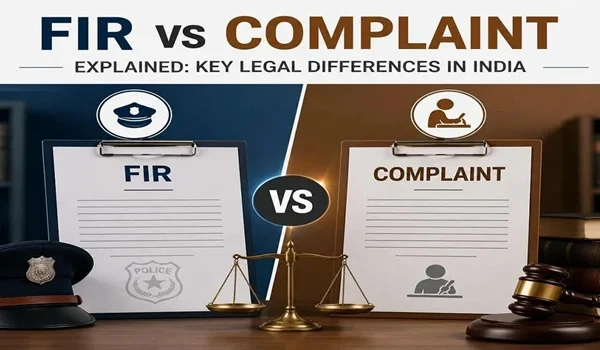
FIR vs Complaint is an important distinction in Indian criminal law. People often use the words “FIR” and “complaint” interchangeably, but they are not the same legal document or procedure.
An FIR (First Information Report) is associated with information given to the police about the commission of a cognizable offence and the commencement of the police investigation process. Under the current criminal-procedure framework, Section 173 of the Bharatiya Nagarik Suraksha Sanhita, 2023 (BNSS) deals with information relating to cognizable offences.
A complaint, in the specific statutory sense under the BNSS, is an allegation made orally or in writing to a Magistrate, requesting action under the Sanhita. The statutory definition expressly excludes a police report.
However, in everyday language, people also call a written application or information submitted to a police station a “complaint.” Therefore, the exact context matters.
FIR vs Complaint: Quick Comparison
| Basis | FIR | Complaint |
| Full form | First Information Report | Complaint |
| Usually made to | Police | Magistrate, when used in the statutory sense |
| Main purpose | Provide information about a cognizable offence to police | Request the Magistrate to take action regarding an alleged offence |
| Relevant law | Section 173 BNSS for information in cognizable cases | Complaint is defined under Section 2(h) BNSS |
| Investigation | Police can investigate a cognizable case according to law | Magistrate may follow the applicable complaint-case procedure or direct investigation where permitted |
| Applies to | Cognizable offences | Can relate to an offence alleged before a Magistrate |
| Police report | FIR is part of the police investigation process | A complaint is legally distinct from a police report |
| Court involvement at beginning | Usually police-led | Magistrate-led in a complaint case |
| Can lead to criminal proceedings? | Yes | Yes |
| Is every police complaint an FIR? | No | No |
What Is an FIR?
An FIR is the formal recording of information relating to the commission of a cognizable offence by the police.
Section 173 of the BNSS provides that information relating to the commission of a cognizable offence may be given orally or by electronic communication to the officer in charge of a police station. Information given orally is reduced to writing and read over to the informant, while electronically communicated information is taken on record after being signed by the person giving it within the prescribed period.
The information is then entered in the prescribed police record.
Example of an FIR
Suppose a person reports that their house was broken into and valuables were stolen.
The person can provide information to the police about the incident. If the information discloses a cognizable offence, the police process under Section 173 BNSS may apply.
The FIR records the initial information. It does not itself establish that the accused person is guilty.
The police subsequently investigate the allegations and collect evidence.
What Is a Complaint?
Under Section 2(h) of the BNSS, a complaint means an allegation made orally or in writing to a Magistrate, with a view to the Magistrate taking action under the Sanhita, alleging that a person, known or unknown, has committed an offence. The statutory definition specifically says that a complaint does not include a police report.
This is different from the way the word “complaint” is commonly used.
For example, if someone says:
“I gave a complaint to the police.”
they may simply mean that they submitted information or an application to the police.
That police application is not automatically a “complaint” in the technical statutory sense under Section 2(h) BNSS.
This distinction is important when discussing criminal procedure.
FIR vs Complaint: Meaning of the Terms
The simplest way to understand the distinction is:
FIR: Information relating to a cognizable offence is given to the police and recorded under the applicable law.
Statutory complaint: An allegation of an offence is made to a Magistrate with a request for action under the BNSS.
Therefore, an FIR is primarily connected with the police investigation route, while a complaint case is associated with the Magistrate/court route.
Who Can File an FIR?
An FIR is not necessarily required to be filed only by the person who suffered the offence.
Information about a cognizable offence can be provided to the police, subject to the requirements of law.
For example, information about a serious offence may be given by:
- Victim
- Family member
- Eyewitness
- Other person having information about the incident
- Person acting on behalf of an affected person, where applicable
The important issue is whether the information discloses a cognizable offence and satisfies the applicable legal requirements.
Who Can File a Complaint Before a Magistrate?
A complaint under the statutory definition is an allegation made to a Magistrate that a person, known or unknown, has committed an offence.
The complainant does not necessarily have to be the direct victim in every situation. Whether a particular person can initiate or maintain a complaint depends on the offence and applicable law.
Special laws can also prescribe particular requirements concerning who may initiate proceedings.
Cognizable and Non-Cognizable Offences
Understanding cognizable vs non-cognizable offences helps explain the difference between police proceedings and complaint cases.
A cognizable offence is one for which the law gives the police authority to arrest without a warrant, subject to the applicable legal conditions.
Under Section 174 BNSS, when information concerning a non-cognizable offence is given to the police, the police are required to enter the substance of the information and refer the informant to the Magistrate. A police officer generally cannot investigate a non-cognizable case without an order of a Magistrate, subject to the provisions of the Sanhita.
This is one reason why simply giving information at a police station does not necessarily result in an FIR.
Can a Complaint Lead to an FIR?
Yes, depending on the facts and the route followed.
A person may initially approach the police with information or an application. If the information discloses a cognizable offence, the police may proceed under the applicable provisions.
Alternatively, a person may approach a Magistrate with a statutory complaint. The Magistrate can follow the procedure applicable to complaint cases and, where the law permits, may direct investigation.
The BNSS specifically provides for situations involving a complaint case and a police investigation concerning the same offence.
Thus, FIR and complaint are not necessarily completely unrelated routes. The procedure can overlap depending on the circumstances.
FIR vs Police Complaint
This is another important distinction.
Police complaint
A person may submit a written application or provide information to the police. In ordinary conversation, this is often called a “police complaint.”
It could concern:
- A cognizable offence
- A non-cognizable offence
- A missing person
- A dispute requiring police attention
- Other information requiring police action
But submitting an application to the police does not automatically mean that an FIR has been registered.
FIR
An FIR is the formal recording of information relating to a cognizable offence under the applicable criminal-procedure law.
Therefore:
Every FIR involves information given to the police, but every application or complaint given to the police is not necessarily an FIR.
FIR vs Complaint Before Magistrate
The distinction becomes clearer when comparing the two formal routes.
| Feature | FIR route | Magistrate complaint route |
| Initial authority | Police | Magistrate |
| Nature | Information about cognizable offence | Allegation of an offence |
| Main objective | Trigger police process/investigation | Seek action from Magistrate |
| Investigation | Police investigation under applicable provisions | May proceed as a complaint case; investigation may be ordered where legally permitted |
| Initial document | FIR/police record | Complaint |
| Court involvement | Usually follows police investigation or later proceedings | Starts with Magistrate’s consideration |
| Result | Investigation may lead to police report and further proceedings | Magistrate may proceed according to complaint-case procedure |
What Happens After an FIR?
An FIR does not mean that the accused has been found guilty.
After an FIR, the police may investigate the allegations.
Depending on the case, investigation may involve:
- Visiting the relevant place
- Examining witnesses
- Collecting documents
- Collecting electronic or digital evidence
- Recovering relevant articles
- Obtaining forensic evidence where appropriate
- Identifying suspects
- Arresting a person where legally justified
- Recording relevant statements
- Completing the investigation
The police then follow the applicable procedure for submitting their report to the court.
The actual outcome depends on the evidence and the applicable law.
What Happens After a Complaint Before a Magistrate?
A Magistrate receiving a complaint follows the procedure prescribed by the BNSS and other applicable law.
Depending on the circumstances, the Magistrate may:
- Examine the complainant and relevant witnesses where required
- Consider supporting material
- Postpone issuance of process in circumstances provided by law
- Order an investigation where legally permissible
- Dismiss the complaint where the legal requirements for proceeding are not satisfied
- Issue process against the accused where the applicable requirements are met
The BNSS contains provisions dealing with complaint cases, including the procedure relating to examination of the complainant, postponement of issue of process, dismissal of a complaint and issue of process.
Is an FIR Necessary for Every Criminal Case?
No.
The criminal-procedure system provides different routes depending on the nature of the offence and the circumstances.
For a cognizable offence, information can be given to the police under Section 173 BNSS. For non-cognizable matters, Section 174 provides a different procedure, including reference to the Magistrate and restrictions on police investigation without a Magistrate’s order.
A complaint before a Magistrate can also be an important route in appropriate cases.
Is a Complaint the Same as a Court Case?
No.
A complaint is an allegation or initiating document. It does not automatically mean that the accused has been found guilty or even that a full criminal trial has begun.
The Magistrate must follow the applicable procedure and determine whether the matter should proceed.
Similarly, registration of an FIR does not mean that a criminal court has convicted anyone.
Does an FIR Mean the Accused Is Guilty?
No.
An FIR contains the initial information concerning an alleged cognizable offence.
It is not a judgment.
The investigation, evidence, court proceedings and applicable legal standards determine what happens subsequently.
Therefore, it is incorrect to treat registration of an FIR as proof of guilt.
Does Filing a Complaint Mean the Accused Is Guilty?
No.
A complaint contains allegations. The Magistrate must follow the applicable legal process before deciding whether proceedings should continue.
An allegation is not equivalent to a conviction.
Can an FIR Be Filed Online?
The BNSS expressly permits information relating to a cognizable offence to be given by electronic communication. Where information is given electronically, it is taken on record after being signed by the person giving it within the prescribed period.
The practical online facility, format and procedure can depend on the relevant police department and State/Union Territory.
Therefore, an online police complaint facility should not automatically be described as identical to an FIR-registration facility.
Always check the acknowledgement and whether an FIR number has actually been assigned.
What If the Police Do Not Register an FIR?
The BNSS provides mechanisms for approaching higher police authorities and the Magistrate in appropriate circumstances.
Under Section 173, the law provides for escalation where information concerning a cognizable offence is not recorded, including approaching the Superintendent of Police and, subject to the statutory requirements, the Magistrate.
The precise procedural route depends on the facts and applicable law.
For an urgent or serious matter, legal advice may be appropriate rather than relying only on an online application.
FIR vs Complaint: Example
Consider a hypothetical example.
Situation
A person alleges that another person assaulted them and caused injuries.
Route 1: Police
The person provides information to the police.
If the information discloses a cognizable offence, the police may record the information under Section 173 BNSS and investigate according to law.
Route 2: Magistrate
In an appropriate situation, the person may approach a Magistrate with a complaint alleging the offence and requesting action.
The Magistrate then follows the procedure applicable to the complaint.
The two routes therefore have different starting points and procedures.
FIR vs Complaint vs Charge Sheet
These three terms should not be confused.
| Term | Meaning |
| FIR | Initial recorded information relating to a cognizable offence |
| Complaint | Statutory allegation made to a Magistrate seeking action under the BNSS |
| Police report after investigation | Report submitted by police following investigation, according to the applicable procedure |
| Charge | Formal accusation framed by the court where the case reaches that stage |
An FIR occurs near the beginning of the police-investigation route. A police report comes after investigation. A charge, where framed, is part of the court proceedings.
FIR vs Complaint: Key Differences at a Glance
- Authority
An FIR is recorded through the police process.
A statutory complaint is made to a Magistrate.
- Nature
An FIR records information about a cognizable offence.
A complaint is an allegation requesting Magistrate action.
- Investigation
An FIR concerning a cognizable case can lead to police investigation under the BNSS.
A complaint can proceed through the Magistrate’s complaint-case procedure and may, where legally permitted, result in an investigation being ordered.
- Court involvement
The FIR route begins with the police.
The statutory complaint route begins before a Magistrate.
- Legal meaning
“Complaint” has a broader everyday meaning, but the BNSS gives it a specific statutory definition.
- Outcome
Neither an FIR nor a complaint itself establishes guilt.
A person’s criminal liability is determined through the applicable legal process.
Common Misunderstandings About FIR and Complaint
“Every complaint becomes an FIR.”
Not necessarily. A complaint or application submitted to the police is not automatically an FIR.
“An FIR proves the offence.”
No. It records initial information and can trigger investigation.
“A complaint can only be given to the police.”
In everyday language this may be common usage, but under the statutory definition of “complaint” in the BNSS, it refers to an allegation made to a Magistrate for action under the Sanhita.
“Only the victim can give an FIR.”
The law does not make the FIR process dependent in every case on the victim personally being the informant.
“An FIR and a charge sheet are the same.”
They are not. The FIR concerns the initial information; the police report follows investigation.
Which One Should You Use: FIR or Complaint?
There is no universal answer because the appropriate procedure depends on the nature of the alleged offence, available facts, evidence and applicable law.
As a general framework:
- If information discloses a cognizable offence, the police route under Section 173 BNSS may apply.
- For non-cognizable offences, Section 174 BNSS provides a different process.
- A statutory complaint before a Magistrate may be appropriate in circumstances where the law permits or requires that route.
- Special laws may provide additional procedures.
For a specific dispute, a lawyer can determine the appropriate procedural route after examining the facts.
Documents to Keep After Filing an FIR or Complaint
Keep copies of all relevant documents, including:
- FIR copy, if registered
- Police complaint/application
- Acknowledgement or diary/DD/GD reference, where applicable
- CNR or court case number if court proceedings begin
- Medical documents
- Photographs/videos
- Relevant messages or emails
- Witness details
- Notices received from authorities
- Court orders
- Other supporting documents
Do not alter or delete potentially relevant evidence.
FAQs
Is an FIR and complaint the same?
No. A statutory complaint under the BNSS is an allegation made to a Magistrate seeking action. An FIR is associated with information concerning a cognizable offence given to the police and recorded under the applicable procedure.
Can I file a complaint without an FIR?
Yes. A statutory complaint before a Magistrate is a distinct procedural route. Whether it is appropriate depends on the facts and applicable law.
Can an FIR be filed without a complaint?
Yes. Information concerning a cognizable offence can be given to the police under Section 173 BNSS. The informant does not necessarily have to first file a separate statutory complaint before a Magistrate.
Does every police complaint become an FIR?
No. A police application, information or complaint does not automatically mean that an FIR has been registered.
Is a complaint always filed in court?
A statutory complaint under Section 2(h) BNSS is made to a Magistrate. However, people commonly use “complaint” to describe an application or information submitted to police, so the context must be checked.
Can a complaint lead to police investigation?
Yes, where the applicable legal procedure permits the Magistrate to direct an investigation. The BNSS contains provisions dealing with complaint cases and police investigation.
Does an FIR mean the accused will be arrested?
No. Registration of an FIR and arrest are separate legal matters. Whether arrest is necessary and lawful depends on the circumstances and applicable law.
Does an FIR mean the accused will be convicted?
No. An FIR is not a finding of guilt. The eventual outcome depends on investigation, evidence and court proceedings.
Can an FIR be filed electronically?
Section 173 BNSS permits information relating to a cognizable offence to be given by electronic communication, subject to the statutory requirement concerning signature within the prescribed period.
What is the main difference between FIR and complaint?
The simplest distinction is that an FIR is part of the police process for information concerning a cognizable offence, while a statutory complaint is an allegation made to a Magistrate seeking action under the BNSS.
Conclusion
The difference between an FIR and a complaint mainly concerns the authority approached, the nature of the information or allegation and the procedure that follows.
An FIR is connected with information about a cognizable offence given to the police under Section 173 of the BNSS. A statutory complaint, on the other hand, is an allegation made to a Magistrate requesting action under the law.
One important point is that the word “complaint” is commonly used in two different ways. A person may call an application submitted to the police a complaint, while the BNSS uses “complaint” as a defined legal term referring to an allegation made to a Magistrate.
Neither an FIR nor a complaint by itself proves guilt. They are starting points in different procedural routes, and the subsequent investigation and court process determine what happens to the allegations.