The court case process in India depends on the type of dispute, the applicable law and the court or forum handling the matter. A civil case, criminal case, family matter, commercial dispute or case before a specialised tribunal can follow different procedures.
However, most court proceedings involve a series of recognisable stages, starting with identifying the legal remedy and filing the appropriate document and continuing through hearings, evidence, arguments and the final judgment or order.
For civil matters, the Code of Civil Procedure, 1908 (CPC) provides a general procedural framework, subject to special laws and court-specific rules. Criminal proceedings currently operate primarily under the Bharatiya Nagarik Suraksha Sanhita, 2023 (BNSS), while offences are generally defined under the Bharatiya Nyaya Sanhita, 2023 (BNS) and evidence is governed by the Bharatiya Sakshya Adhiniyam, 2023, subject to applicable special laws.
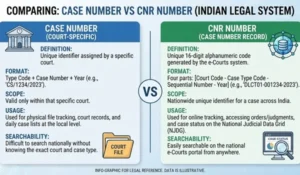
The e-Courts system also provides online access to case status, cause lists and court orders. Cases can be searched using information such as CNR number, case number, filing number, party name, advocate name, FIR number, Act or case type.
Court Case Process in India: Quick Overview
| Stage | What Happens |
| 1 | Identify the legal issue |
| 2 | Choose the appropriate legal remedy |
| 3 | Identify the correct court or forum |
| 4 | Check limitation and procedural requirements |
| 5 | Collect documents and evidence |
| 6 | Prepare plaint, complaint, petition or other filing |
| 7 | File the case |
| 8 | Registry scrutiny and removal of defects |
| 9 | Case registration and number |
| 10 | Notice or summons to the other side |
| 11 | Preliminary/interim proceedings |
| 12 | Written statements, replies or pleadings |
| 13 | Framing of issues or charges, where applicable |
| 14 | Evidence and examination of witnesses |
| 15 | Cross-examination |
| 16 | Final arguments |
| 17 | Judgment or final order |
| 18 | Execution or sentencing, where applicable |
| 19 | Appeal or other legal remedy, where available |
Not every case passes through every stage in exactly this order.
Step 1: Identify the Legal Problem
The process starts before anything is filed in court.
You first need to understand what happened and what legal remedy you want.
For example, the issue may involve:
- Property ownership
- Money recovery
- Breach of contract
- Family dispute
- Consumer complaint
- Employment dispute
- Commercial disagreement
- Alleged theft
- Assault
- Fraud or cheating
- Injunction
- Compensation
The nature of the problem determines the type of proceeding that may be appropriate.
A dispute should not automatically be treated as a civil or criminal case merely because of the language used by the parties. The facts and applicable law determine the legal character of the matter.
Step 2: Determine the Type of Case
The next step is to identify whether the matter is:
- Civil
- Criminal
- Family
- Commercial
- Consumer
- Constitutional
- Administrative
- Tribunal-related
- Arbitration or another alternative dispute-resolution proceeding
Civil Cases
Civil proceedings commonly concern:
- Property
- Contracts
- Recovery of money
- Possession
- Injunctions
- Damages
- Certain family and succession disputes
Criminal Cases
Criminal cases concern alleged offences.
The current general criminal framework includes the BNS for offences and the BNSS for criminal procedure.
Depending on the case, a criminal matter may begin through the police or through a complaint before a Magistrate.
Step 3: Identify the Correct Court
A case must generally be filed before the court or forum having jurisdiction.
Jurisdiction can depend on:
- Location of the parties
- Location of the property
- Where the cause of action arose
- Subject matter
- Monetary value where applicable
- Nature of the offence
- Statutory requirements
- Applicable territorial rules
For example, certain property disputes are governed by specific territorial rules under the CPC.
Specialised matters may also have to be filed before a particular court, commission or tribunal rather than an ordinary civil court.
Examples of Specialised Forums
Depending on the dispute, a matter may come before:
- Family Court
- Commercial Court
- Consumer Commission
- National Company Law Tribunal
- Debt Recovery Tribunal
- Labour or industrial forum
- Other statutory tribunals or authorities
Choosing the wrong forum can create procedural problems, so jurisdiction should be checked before filing.
Step 4: Check the Limitation Period
Many legal proceedings have a prescribed time limit.
The Limitation Act, 1963 contains limitation rules for many civil proceedings, while special laws may prescribe their own periods.
The limitation period depends on the nature of the claim.
Factors that can matter include:
- Date of the cause of action
- Date of default
- Date of knowledge in situations where the law makes it relevant
- Acknowledgment of liability
- Continuing causes of action
- Statutory extensions or exclusions
Because limitation can be complicated, it is important to calculate it based on the specific facts and applicable law.
Step 5: Collect Documents and Evidence
Before filing, collect all relevant documents.
These can include:
- Agreements
- Sale deeds
- Property records
- Invoices
- Receipts
- Bank statements
- Emails
- Letters
- WhatsApp or other electronic communications
- Photographs
- Videos
- Medical records
- Police documents
- Notices
- Replies
- Witness details
- Previous court orders
Keep original documents safely and provide copies as required by the court or lawyer.
Electronic evidence should also be preserved carefully.
Step 6: Consult a Lawyer
A lawyer can help determine:
- The applicable law
- The appropriate court
- Limitation
- Necessary parties
- Legal remedies
- Drafting requirements
- Evidence
- Court fees
- Filing procedure
- Interim relief
- Appeal options
Whether professional representation is necessary depends on the proceeding and circumstances. However, legal advice can be particularly useful for complicated property, criminal, family, commercial or high-value disputes.
Eligible persons can also seek free legal services through the legal-services system where the statutory requirements are satisfied.
Step 7: Prepare the Case
The document used to start a proceeding depends on the nature of the case.
Civil Case
A civil suit is generally initiated through a plaint, subject to the CPC and any applicable special law.
The plaint normally explains:
- Parties
- Material facts
- Cause of action
- Jurisdiction
- Relief sought
- Valuation
- Court-fee details where applicable
- Supporting documents
Criminal Case
A criminal matter can begin through different routes depending on the circumstances.
It may involve:
- Information to the police
- Investigation
- A complaint before a Magistrate
- A proceeding under a special criminal statute
The applicable procedure depends on the offence and circumstances.
Step 8: File the Case
A case may be filed physically or electronically where the relevant court has adopted e-Filing.
The official e-Filing system states that litigants and advocates can file cases and applications from their offices or homes, upload pleadings in PDF form, e-sign documents and make online court-fee payments where supported. It supports both civil and criminal cases before participating High Courts and District Courts.
The exact filing process varies between courts.
Step 9: Registry Scrutiny
After filing, the court registry examines the documents for procedural compliance.
Possible defects may include:
- Missing documents
- Incorrect formatting
- Incomplete party details
- Improper signatures
- Insufficient court fee
- Missing authorisation
- Incorrect case classification
- Other procedural deficiencies
If defects are raised, they normally have to be corrected according to the applicable procedure.
The e-Filing system also has an acceptance process. Its official manual explains that electronically filed cases can remain pending acceptance, and cases that are not accepted can be resubmitted after curing defects.
Step 10: Case Registration
Once the filing satisfies the applicable requirements, the case can be registered.
The case receives identifying information such as:
- Filing number
- Registration/case number
- Case type
- Year
- Court details
- CNR number where generated
A CNR number can be particularly useful for tracking a case through e-Courts.
The e-Courts system allows users to search case status using a CNR number and view the current status and case history.
Step 11: Notice or Summons
After registration and the appropriate preliminary steps, the court may issue notice or summons to the other party.
In a civil case, the defendant generally needs to be served with the court’s process.
In criminal proceedings, the court can issue the appropriate process depending on the procedural stage and circumstances.
Service of notice is an important procedural step because the opposing party must generally receive an opportunity to respond according to law.
Step 12: Appearance of the Parties
The parties or their authorised representatives appear before the court on the dates fixed.
Depending on the case, appearance can involve:
- Plaintiff
- Defendant
- Complainant
- Accused
- Advocates
- Government counsel
- Witnesses
- Other authorised persons
Personal presence is not necessarily required at every hearing in every case. Whether a party must personally appear depends on the court’s directions and applicable procedure.
Step 13: Interim Applications
A case does not always wait until final judgment for every issue to be decided.
Parties may seek interim relief during the proceedings.
Examples can include applications concerning:
- Temporary injunction
- Protection of property
- Interim custody
- Stay of particular action
- Preservation of evidence
- Bail in criminal proceedings
- Other temporary relief
The availability of interim relief depends on the law and facts of the case.
An interim order is generally different from a final judgment on the entire dispute.
Step 14: Filing of Written Statements and Replies
In civil proceedings, the defendant may file a written statement responding to the plaintiff’s allegations.
The response may:
- Admit certain facts
- Deny allegations
- Explain the defendant’s version
- Raise legal objections
- Raise jurisdictional issues
- Put forward relevant defences
Other proceedings may involve replies, objections, counterclaims or other pleadings depending on the applicable rules.
Step 15: Framing of Issues in Civil Cases
In an ordinary civil trial, the court may identify the material questions of fact or law that need determination.
These are known as issues.
For example, in a property dispute, issues could concern:
- Whether the plaintiff has valid title
- Whether the defendant is in possession
- Whether a particular document is legally effective
- Whether the claim is within limitation
The issues guide the evidence and eventual decision.
Step 16: Framing of Charges in Criminal Cases
In a criminal trial where charges are required to be framed, the court considers the applicable material and determines the charges to be tried according to the criminal procedure.
The accused then faces trial on the charges as determined by the court, subject to subsequent procedural developments.
Framing of a charge is not a finding of guilt.
The prosecution still has to establish the case according to the applicable criminal standard.
Step 17: Evidence Stage
Evidence is one of the most important stages of a court case.
In a civil case, parties may present:
- Documents
- Witnesses
- Expert evidence
- Electronic records
- Other admissible material
In a criminal case, the prosecution may present evidence to establish the alleged offence, while the accused has the procedural rights available under criminal law.
The applicable evidence law and court procedure determine how evidence is admitted and considered.
Step 18: Examination and Cross-Examination of Witnesses
Where witnesses are examined, the process can involve:
- Examination-in-chief
- Cross-examination
- Re-examination, where applicable
Examination-in-Chief
The witness gives evidence supporting the party who has called the witness, subject to the applicable rules.
Cross-Examination
The opposing side gets an opportunity to question the witness.
Cross-examination can test:
- Accuracy
- Memory
- Consistency
- Knowledge
- Credibility
- Contradictions
Re-Examination
Where permitted and necessary, the witness may be re-examined to clarify matters arising from cross-examination.
Not every proceeding involves the same witness process.
Step 19: Final Arguments
After evidence is completed, the parties present their legal arguments.
The arguments generally explain:
- What facts have been established
- Which evidence supports the case
- Which legal provisions apply
- Why the court should grant or reject the requested relief
In a civil case, the plaintiff and defendant present their respective positions.
In a criminal trial, the prosecution and defence make their respective arguments.
Step 20: Judgment or Final Order
After considering the pleadings, evidence and arguments, the court delivers its judgment or order.
Civil Case
A civil judgment may determine issues such as:
- Ownership
- Possession
- Liability
- Money recovery
- Contractual rights
- Injunction
- Damages
The resulting decree or order can specify the relief granted.
Criminal Case
A criminal judgment may result in:
- Acquittal
- Conviction
If there is a conviction, sentencing follows according to the applicable law.
A criminal allegation, FIR or charge does not itself establish guilt.
Step 21: Execution of a Civil Decree
Winning a civil case does not always mean the matter is immediately finished.
If the judgment or decree requires a party to:
- Pay money
- Deliver property
- Hand over possession
- Perform another legally enforceable obligation
and the losing party does not comply voluntarily, the successful party may need to initiate execution proceedings.
Execution is the process through which the court’s decree is enforced according to law.
Therefore, the litigation process can extend beyond the judgment itself.
Step 22: Sentencing in a Criminal Case
If an accused is convicted, the court proceeds to sentencing according to the applicable law.
Depending on the offence and statutory provisions, punishment may include:
- Imprisonment
- Fine
- Community service where prescribed
- Other legally permitted consequences
The BNS specifies punishments for offences, while the BNSS contains procedural provisions relating to criminal courts and sentencing.
Step 23: Appeal or Other Legal Remedy
A party who is dissatisfied with a judgment or order may have a right to challenge it through:
- Appeal
- Review
- Revision
- Other statutory remedies
However, not every order is automatically appealable.
The available remedy depends on:
- Type of case
- Nature of order
- Court that passed it
- Applicable statute
- Limitation period
The time limit for filing an appeal or other remedy should be checked immediately after receiving the judgment or order.
Civil Court Case Process in India
A simplified civil case process can be represented as:
Dispute → Legal advice → Limitation check → Jurisdiction → Draft plaint → Filing → Registry scrutiny → Registration → Summons → Written statement → Issues → Evidence → Cross-examination → Arguments → Judgment → Decree → Execution/Appeal
The actual sequence can vary.
Some cases may settle before trial, while others may involve interim applications, amendments, commissions, mediation or other procedural steps.
Criminal Court Case Process in India
A simplified criminal case process can be represented as:
Alleged offence → Police information/complaint → Investigation where applicable → Evidence collection → Police report/complaint proceedings → Court proceedings → Charges where applicable → Prosecution evidence → Cross-examination → Defence stage → Arguments → Judgment → Sentencing if convicted → Appeal
The precise procedure depends on the offence and how the criminal proceeding began.
How to Track a Court Case in India
The official e-Courts services provide several ways to track cases.
A case can be searched using:
- CNR number
- Case number
- Filing number
- Party name
- Advocate name
- FIR number
- Act
- Case type
The High Court e-Courts service also provides access to case status, orders/judgments and cause lists.
The e-Courts system also provides cause-list services for civil and criminal matters. Users can select the state, district, court complex, court and date to view the relevant cause list.
What Is a CNR Number?
A CNR (Case Number Record) number is a unique case identifier used in the e-Courts system.
If you know the CNR number, you can use the e-Courts case-status service to access the case’s current status and history.
If you do not know the CNR number, the system provides alternative search methods such as party name, case number, filing number and advocate name.
What Is a Cause List?
A cause list is the list of cases scheduled before a particular court on a specified date.
It can help a litigant or lawyer identify:
- Court number
- Judge
- Case details
- Hearing date
- Civil or criminal listing
The e-Courts service allows users to search cause lists by court and date.
Why Court Cases Take Time
The duration of a case can vary significantly.
Factors can include:
- Number of parties
- Complexity of legal issues
- Number of witnesses
- Volume of documents
- Interim applications
- Service of notices
- Adjournments
- Availability of the court
- Expert evidence
- Appeals
- Execution proceedings
- Settlement or mediation efforts
Therefore, there is no universal period within which every Indian court case will be completed.
The e-Courts system itself provides case-status and pendency information, reflecting the large and varied volume of proceedings handled by Indian courts.
Can a Court Case Be Settled?
Yes, some disputes can be resolved through settlement.
Depending on the type of case, parties may explore:
- Negotiation
- Mediation
- Conciliation
- Lok Adalat
- Other legally recognised settlement mechanisms
Settlement is generally more relevant to disputes where the law permits compromise. Not every criminal offence or legal proceeding can simply be withdrawn or settled privately.
The court or appropriate forum may need to record or approve a settlement depending on the case.
Common Mistakes During a Court Case
- Missing a Hearing or Deadline
Always keep track of hearing dates and filing deadlines.
- Ignoring Court Notices
A notice or summons should not be ignored.
- Losing Original Documents
Keep original documents safely.
- Giving Inconsistent Statements
Facts stated in pleadings and evidence should be accurate and consistent.
- Filing in the Wrong Court
Jurisdiction should be checked before filing.
- Missing Limitation
A delay can affect the legal remedy available.
- Assuming Filing Means Winning
Registration of a case does not establish that the claimant or prosecution will succeed.
- Treating an Interim Order as Final
An interim order is generally temporary or procedural and should not automatically be treated as the final decision.
- Ignoring Execution
A civil decree may require separate execution if the losing party does not comply.
- Missing Appeal Deadlines
If a party wants to challenge a judgment, the applicable limitation period should be checked immediately.
Court Case Process: Civil vs Criminal
| Stage | Civil Case | Criminal Case |
| Starting point | Plaint/petition/application | Police information/FIR or complaint, depending on case |
| Main parties | Plaintiff and defendant | Prosecution/State and accused |
| Preliminary stage | Filing and scrutiny | Complaint/investigation and court process |
| Pleadings | Plaint and written statement | Complaint, police report and applicable responses |
| Issues/charges | Issues may be framed | Charges may be framed where applicable |
| Evidence | Parties produce evidence | Prosecution and defence stages |
| Witnesses | Examination and cross-examination where applicable | Examination and cross-examination where applicable |
| Final arguments | Plaintiff and defendant | Prosecution and defence |
| Final result | Judgment/decree/order | Acquittal or conviction |
| After final decision | Execution/appeal where applicable | Sentencing/appeal where applicable |
Court Case Process Checklist
Before and during a case, keep track of:
- Legal issue identified
- Correct legal remedy identified
- Applicable law checked
- Limitation checked
- Correct court/forum identified
- Necessary parties identified
- Documents collected
- Evidence preserved
- Pleadings prepared
- Court fee checked
- Case filed
- Filing objections addressed
- Case number/CNR recorded
- Notice/summons monitored
- Hearing dates recorded
- Replies filed on time
- Evidence prepared
- Interim orders followed
- Judgment obtained
- Execution considered where applicable
- Appeal/review/revision deadline checked
FAQs
How long does a court case take in India?
There is no fixed duration for all cases. Time depends on the court, case type, complexity, evidence, number of parties, procedural steps and other circumstances.
What happens after filing a court case?
The filing is generally scrutinised by the registry. After defects, if any, are addressed and the matter is registered, the court can issue appropriate process and the case proceeds through the stages applicable to that type of proceeding.
Can I check my case status online?
Yes. e-Courts provides online case-status services. You can search using a CNR number or, where available, details such as case number, filing number, party name, advocate name, FIR number, Act or case type.
What is the difference between filing number and case number?
A filing number identifies the filing submitted to the court, while a registered case receives a case number after the matter is registered according to the applicable procedure. Both can be useful for tracking the matter.
What happens if the other party does not appear?
The court may take appropriate procedural steps depending on the circumstances and applicable law. The consequences can differ between civil and criminal proceedings.
Does every case go to trial?
No. Some matters may be disposed of through settlement, withdrawal, preliminary orders, dismissal, compromise, mediation or other procedures without a full trial.
Can a court judgment be challenged?
A judgment or order may be challengeable through an appeal, review, revision or another remedy where the applicable law provides for it. The available remedy and limitation period depend on the case.
What happens after winning a civil case?
If the judgment requires the other party to do something and they do not comply voluntarily, the successful party may need to initiate execution proceedings.
Can a criminal case end in acquittal?
Yes. A criminal case can end in acquittal when the accused is not convicted through the applicable judicial process.
Can I file a case online?
Online filing is available through the official e-Filing system in courts that have adopted it. The system supports civil and criminal filings and electronic submission of pleadings and documents.
Conclusion
The court case process in India generally moves from identifying the legal issue and selecting the correct remedy to filing, scrutiny, registration, notice, pleadings, evidence, arguments and judgment. What happens after judgment depends on the nature of the case and may include execution, sentencing or an appeal.
Civil and criminal proceedings follow different legal frameworks and should not be treated as identical. Specialised courts and tribunals can also have their own procedures.
The e-Courts system makes it possible to track many cases online through CNR number, case number, filing number, party name and other search criteria, while the e-Filing system allows electronic filing in participating courts.
Because procedural requirements can differ by case type, court, state and applicable legislation, anyone involved in an actual dispute should check the rules applicable to that particular proceeding and obtain professional legal advice where necessary.