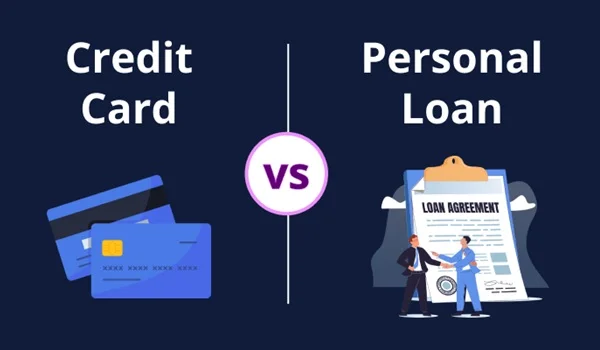
A personal loan and a credit card both allow individuals to borrow money, but they work in very different ways.
A personal loan generally provides a fixed amount of money upfront, which the borrower repays over a predetermined period, usually through EMIs. A credit card provides a revolving credit facility that can be used repeatedly up to an approved credit limit. The cardholder can avoid interest on eligible purchases by paying the total amount due within the applicable payment period, subject to the card’s terms.
The difference becomes particularly important when a person is deciding how to finance a large expense, manage a short-term cash requirement or repay an existing credit card balance.
Personal Loan vs Credit Card: Quick Comparison
| Feature | Personal Loan | Credit Card |
| Type of credit | Usually a fixed-term loan | Revolving credit facility |
| Amount available | Generally disbursed as a defined loan amount | Available up to sanctioned credit limit |
| Repayment | Usually through EMIs | Monthly statement payment |
| Collateral | Usually unsecured | Generally unsecured |
| Interest | Charged according to loan terms | Depends on transactions, payment behaviour and card terms |
| Tenure | Predetermined | No fixed tenure for the revolving facility |
| Reuse of credit | Generally requires a new loan/top-up facility | Available again as credit limit is restored |
| Best suited to | Defined borrowing requirement | Repeated purchases and short-term payment convenience |
| Interest-free period | Not generally structured like a credit-card grace period | May apply to eligible purchases when total amount due is paid on time |
| Minimum payment | EMI or scheduled amount | Minimum amount due may be paid, but interest can continue |
| Main risk | Long-term debt obligation | Revolving balances can become expensive if not cleared |
What Is a Personal Loan?
A personal loan is generally an unsecured loan provided by a bank, NBFC or other eligible lender.
The borrower receives a specified loan amount and agrees to repay it over an agreed tenure.
For example, a borrower may obtain a personal loan of ₹3 lakh for a permitted personal requirement. The lender specifies the interest rate, tenure, EMI and applicable charges. The borrower then makes the scheduled repayments until the loan is closed.
Personal loans are commonly used for:
- Medical expenses
- Weddings
- Home-related expenses
- Travel
- Emergency requirements
- Debt consolidation, where permitted
- Other eligible personal needs
The actual permitted use depends on the lender and product.
What Is a Credit Card Loan?
The term “credit card loan” can be misleading because a normal credit card is not the same as a conventional term loan.
A credit card provides a revolving line of credit. The cardholder can make purchases or other eligible transactions up to the available credit limit and then repay the amount according to the card’s billing cycle.
For example, if a card has a ₹1 lakh credit limit and the cardholder spends ₹30,000, the available limit may reduce accordingly. As payments are made and credited, available credit can be restored, subject to the card’s terms.
Some card issuers also offer separate facilities such as:
- EMI conversion
- Credit-card instalment plans
- Loan against credit card
- Cash withdrawal facilities
- Balance transfer or similar products
These are separate facilities and should not automatically be treated as identical to ordinary credit-card purchases.
How Does a Personal Loan Work?
The typical process is:
- Apply for the loan
The borrower submits an application and provides required information and documents.
- Lender assesses eligibility
The lender may consider:
- Income
- Employment or business profile
- Credit history
- Existing debt
- Banking information
- Age
- Loan amount
- Repayment capacity
- Loan is approved
If the application meets the lender’s criteria, the lender communicates the applicable terms.
- Amount is disbursed
The approved amount is generally credited to the borrower’s account, subject to the loan agreement.
- Borrower pays EMIs
The borrower repays the principal and interest through scheduled instalments.
The loan generally ends after all required repayments and charges have been paid.
How Does a Credit Card Work?
A credit card works differently.
- Credit limit is approved
The card issuer provides a credit limit based on its assessment and applicable card terms.
- Cardholder makes purchases
The card can be used at eligible merchants and for other permitted transactions.
- Statement is generated
At the end of the billing cycle, the issuer generates a statement showing the transactions and amounts payable.
- Cardholder makes payment
The cardholder may have to pay:
- Total amount due
- Minimum amount due
- Or another amount, depending on the payment made
Paying the total amount due by the due date can allow the cardholder to retain the applicable interest-free period for eligible purchases, subject to the card’s terms.
If the total amount due is not cleared, interest and other applicable charges can arise.
RBI specifically states that if a cardholder makes only a partial payment and does not clear the total amount due by the due date, the interest-free credit period is lost and interest may be levied on the outstanding amount according to the applicable rules.
Personal Loan vs Credit Card Interest
Interest is one of the biggest differences between these forms of borrowing.
Personal loan
A personal loan normally has a stated interest rate and repayment schedule.
The borrower knows the loan amount, tenure and scheduled EMI at the time of taking the loan, subject to the applicable terms.
Credit card
Credit-card costs can work differently.
If the total amount due is paid on time, eligible purchases may receive an interest-free period according to the card’s terms.
However, carrying an unpaid balance from one billing cycle to another can result in interest charges.
This makes it important to understand the difference between:
Total amount due and minimum amount due.
Paying only the minimum amount due does not generally mean that the entire balance has been cleared.
RBI has required credit-card issuers to clearly communicate the implications of paying only the minimum amount due, including that repayment can stretch over a long period with interest costs.
Personal Loan EMI vs Credit Card Payment
A personal loan normally has a structured repayment schedule.
For example:
Loan amount: ₹3 lakh
Tenure: 3 years
Repayment: Monthly EMI
The borrower knows that a scheduled payment is due each month.
A credit card does not work in exactly the same way.
Suppose a cardholder spends ₹60,000 during a billing cycle. The statement will specify the total amount due and minimum amount due. If the cardholder pays the entire ₹60,000 by the due date, the applicable interest-free treatment for eligible purchases can generally be retained.
If the cardholder pays only part of the amount, interest may apply according to the card terms and applicable regulations.
Personal Loan vs Credit Card for Large Expenses
For a large, planned expense, a personal loan may provide a more structured repayment arrangement because the borrower receives a defined amount and repays it over a predetermined tenure.
A credit card can also be used for large purchases, but carrying a substantial unpaid balance can become expensive.
Therefore, the comparison should include:
- Amount required
- Interest cost
- Repayment period
- Processing fees
- Credit-card charges
- EMI options
- Ability to repay the balance
- Total borrowing cost
The cheapest option cannot be determined solely from the product name because actual rates and charges vary.
Personal Loan vs Credit Card for Small Purchases
For routine purchases, a credit card can provide payment convenience and, where applicable, an interest-free period if the total amount due is paid on time.
Taking a personal loan for every small purchase may not be practical because personal loans involve an application, documentation and a defined repayment structure.
However, using a credit card does not make spending free. The amount still has to be repaid.
Personal Loan vs Credit Card for Emergency Expenses
Both can provide access to funds, but they operate differently.
A personal loan may be suitable when a borrower needs a defined amount and wants a structured repayment schedule.
A credit card can provide immediate access to available credit if the cardholder already has sufficient unused limit.
However, if the emergency expense results in a large revolving balance, interest can accumulate until the balance is repaid.
Personal Loan vs Credit Card: Credit Limit
A personal loan provides a specific sanctioned amount.
For example:
Personal loan sanctioned: ₹5 lakh
The borrower receives the loan according to the lender’s disbursal terms.
A credit card instead provides a revolving limit.
For example:
Credit limit: ₹2 lakh
The cardholder can use the available limit for eligible transactions. As payments are made, the available limit can be restored.
This makes credit cards more flexible for repeated short-term transactions.
Personal Loan vs Credit Card: Repayment Flexibility
Personal loans generally have less flexibility because the borrower has a predetermined repayment schedule.
Credit cards provide greater payment flexibility because the cardholder can generally pay the total amount due or at least the required minimum amount by the due date.
However, this flexibility can become expensive if the balance is repeatedly carried forward.
The minimum amount due is not the same as clearing the outstanding balance.
Personal Loan vs Credit Card: Fees and Charges
Both products can involve charges.
Personal loan charges may include:
- Processing fee
- Documentation charges
- Applicable penal charges
- Prepayment or foreclosure-related charges where permitted
- Other disclosed fees
Credit-card charges may include:
- Annual or renewal fee
- Late payment charges
- Interest charges
- Cash advance charges
- Foreign currency transaction charges
- EMI conversion charges
- Other applicable fees
The actual charges vary by lender and product.
For applicable loan products, RBI requires regulated entities to disclose key loan information and applicable charges through the prescribed framework.
What Is Better for Building Credit History?
Both personal loans and credit cards can form part of a person’s credit history.
What matters significantly is repayment behaviour.
Consistently making payments on time can help maintain a healthy credit record, while overdue payments and defaults can negatively affect credit information.
A borrower should therefore avoid taking either product simply to increase the number of credit accounts.
Effect on Credit Utilisation
Credit-card usage can also affect credit utilisation.
For example, if a person has a total credit-card limit of ₹2 lakh and regularly carries a balance close to that limit, the utilisation level can become relatively high.
A personal loan works differently because it is generally a fixed loan account rather than revolving credit.
Credit utilisation is one factor that can be considered in credit scoring, although different credit information companies use their own scoring methodologies.
Personal Loan vs Credit Card: Which Has a Fixed Tenure?
A personal loan generally has a fixed tenure.
For example:
- 12 months
- 24 months
- 36 months
- 60 months
The exact options depend on the lender.
A normal credit card does not have a fixed repayment tenure for the revolving facility. The card remains available subject to the issuer’s terms, account status and credit limit.
If a credit-card transaction is converted into an EMI facility, however, that particular transaction or balance may have a defined repayment period.
Credit Card EMI vs Personal Loan
Credit-card issuers may allow eligible purchases or outstanding balances to be converted into EMIs.
This can make the repayment structure more similar to a personal loan.
However, the two should still be compared carefully.
| Factor | Personal Loan | Credit Card EMI |
| Initial structure | Dedicated loan | Card transaction/balance converted into instalments |
| Loan amount | Defined at sanction | Usually based on eligible transaction/limit |
| Repayment | Scheduled EMI | Scheduled EMI |
| Processing/other charges | May apply | May apply |
| Interest | Based on loan terms | Based on card EMI terms |
| Credit limit impact | Generally separate from card limit | Can affect available card limit |
| Prepayment terms | Product-specific | Product-specific |
The actual cost should be checked before accepting the EMI conversion.
Example: Personal Loan vs Credit Card
Suppose Amit needs ₹1 lakh for a planned expense.
Option 1: Personal loan
He obtains a ₹1 lakh personal loan and agrees to repay it over a specified tenure through EMIs.
His total repayment will include the principal, interest and applicable charges.
Option 2: Credit card
He pays ₹1 lakh using his credit card.
If he pays the total amount due by the due date and the transaction qualifies for the card’s interest-free period, he may avoid interest on that purchase.
However, if he pays only a portion and carries the remaining balance, interest can be charged according to the card’s terms.
This is why the payment strategy is particularly important when using a credit card for a large purchase.
Advantages of Personal Loans
Structured repayment
The borrower generally knows the EMI and repayment tenure from the beginning.
Fixed borrowing amount
The borrower receives a defined amount rather than relying on a revolving credit limit.
Suitable for planned borrowing
A personal loan can be useful when a borrower knows exactly how much money is required.
No specific collateral for typical personal loans
Most standard personal loans are unsecured, although product structures can vary.
Limitations of Personal Loans
- Interest is generally charged according to the loan agreement.
- Processing fees and other charges may apply.
- The borrower takes on a fixed repayment obligation.
- Taking a loan for longer than necessary can increase total interest.
- Early repayment may be subject to product-specific conditions.
Advantages of Credit Cards
Convenience
Credit cards can be used for eligible purchases without applying for a new loan each time.
Revolving credit
The available credit can generally be reused as repayments restore the limit.
Interest-free period on eligible purchases
Paying the total amount due within the applicable period can avoid interest on eligible purchases, subject to the card’s terms.
Additional features
Depending on the card, users may receive rewards, cashback, discounts or other benefits.
These features vary widely between cards and should not be treated as a substitute for evaluating borrowing costs.
Limitations of Credit Cards
High cost when balances are carried
Carrying an unpaid balance can result in significant interest charges.
Minimum payment can be misleading
Paying the minimum amount due keeps the account from being treated as unpaid under the applicable card terms, but it does not clear the outstanding balance.
Easy access can encourage overspending
Because the credit limit is available repeatedly, it can be easy to spend more than planned.
Additional charges
Annual fees, late charges, cash advance charges and other fees may apply depending on the card.
Personal Loan vs Credit Card: Key Decision Factors
Before choosing between the two, consider:
How much do you need?
For a defined large requirement, compare personal-loan offers with available card-based options.
How quickly can you repay?
If you can clear an eligible credit-card purchase in full by the due date, the cost structure can be very different from carrying the balance.
Do you need revolving credit?
If you frequently make purchases and repay them regularly, a credit card can provide ongoing access to credit.
Do you need a fixed EMI?
If predictable monthly repayments are important, a personal loan or properly structured EMI facility may provide greater certainty.
What is the total cost?
Do not compare only the headline interest rate. Include fees, charges and the repayment period.
Important Things to Check Before Borrowing
For a personal loan, check:
- Loan amount
- Interest rate
- Annualised cost/APR where applicable
- Tenure
- EMI
- Processing fee
- Other charges
- Prepayment conditions
- Penal charges
- Total repayment
For a credit card, check:
- Credit limit
- Annual fee
- Interest rate
- Interest-free period
- Total amount due
- Minimum amount due
- Late payment charges
- Cash withdrawal charges
- EMI conversion charges
- Other applicable fees
For regulated lenders, RBI’s framework requires important loan costs and terms to be disclosed through applicable Key Facts Statements and loan documentation.
Frequently Asked Questions
Is a credit card the same as a personal loan?
No. A personal loan is generally a fixed-term loan, while a credit card is a revolving credit facility.
Is a credit card considered a loan?
Credit-card dues represent a form of credit and RBI treats credit-card dues within its regulatory framework for credit facilities, but a normal credit card is not structured like a conventional fixed-term personal loan.
Which is cheaper, a personal loan or credit card?
There is no universal answer. If an eligible credit-card purchase is paid in full within the applicable interest-free period, interest may not be charged on that purchase. Carrying the balance can be costly. Personal loans have their own interest and fee structure, which should be compared using the actual lender terms.
Can I use a credit card instead of taking a personal loan?
Yes, for eligible purchases if you have sufficient available credit. Whether it is suitable depends on the amount, repayment ability, applicable interest and charges.
What happens if I pay only the minimum amount on my credit card?
Paying only the minimum amount due does not clear the entire balance. If the total amount due is not paid by the due date, the applicable interest-free period can be lost and interest may be charged according to the card’s terms and applicable RBI requirements.
Is a personal loan better for a large expense?
A personal loan can provide a defined amount and structured EMI repayment, but whether it is suitable depends on the actual cost, repayment capacity and purpose. The complete terms should be compared with available alternatives.
Can credit-card purchases be converted into EMIs?
Many card issuers offer EMI conversion on eligible transactions or balances, subject to their terms. The interest rate, processing fee, tenure and eligibility should be checked before conversion.
Does a personal loan affect your credit score?
Yes. A personal loan becomes part of your credit history, and repayment behaviour can affect your credit profile.
Does using a credit card affect your credit score?
Yes. Credit-card repayment history and other aspects of credit usage can affect your credit profile.
Conclusion
A personal loan and a credit card are both forms of borrowing, but they serve different purposes.
A personal loan generally provides a fixed amount with a defined repayment schedule, making it suitable for a specific borrowing requirement where structured EMIs are useful. A credit card provides revolving credit, making it convenient for repeated purchases and short-term payment needs.
The most important distinction is what happens when the borrowed amount is not repaid in full. With a personal loan, the repayment schedule is established upfront. With a credit card, carrying an unpaid balance can result in interest and other charges, while paying only the minimum amount due can extend the repayment period.
Before choosing either option, compare the interest cost, fees, repayment period, EMI or minimum payment, total amount payable and your ability to repay on time. The right choice depends on the specific transaction and your financial circumstances rather than the product name alone.