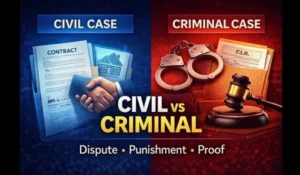
Civil law and criminal law are two major areas of the Indian legal system, but they deal with different types of disputes and legal consequences. Civil law generally deals with disputes involving private rights, obligations, property, contracts, family matters and compensation. Criminal law deals with acts or omissions that are treated as offences and may result in prosecution and punishment by the State.
The distinction is important because the nature of the case, procedure, parties involved, evidence and possible outcome can be different.
India’s current criminal-law framework includes the Bharatiya Nyaya Sanhita, 2023 (BNS) for offences, along with the Bharatiya Nagarik Suraksha Sanhita, 2023 and Bharatiya Sakshya Adhiniyam, 2023. The BNS came into force on 1 July 2024, subject to the commencement notification and specified exception.
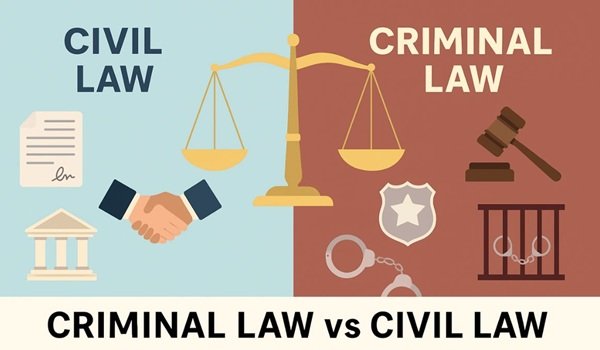
Civil Law vs Criminal Law: Quick Comparison
| Basis | Civil Law | Criminal Law |
| Main purpose | Resolve private disputes and enforce rights | Deal with offences and protect society |
| Typical parties | Plaintiff and defendant | State/prosecution and accused |
| Nature of matter | Dispute between individuals, businesses or other parties | Alleged commission of an offence |
| Common examples | Property, contract, recovery, family disputes | Theft, robbery, assault, cheating and other offences |
| Main objective | Compensation, declaration, injunction or enforcement of rights | Prosecution and punishment where guilt is established |
| Initiation | Usually through a civil suit/application, depending on the matter | Usually through the criminal justice process following information/complaint and investigation |
| Possible outcome | Damages, injunction, declaration, specific relief, recovery, etc. | Acquittal or conviction and sentence according to law |
| Role of State | Generally not the principal opposing party | State/prosecution conducts the criminal case |
| Standard of proof | Generally preponderance of probabilities in civil proceedings | Guilt must generally be proved beyond reasonable doubt |
| Imprisonment | Normally not the usual remedy in an ordinary civil dispute | Imprisonment may be imposed where the applicable offence provides for it |
What Is Civil Law?
Civil law deals broadly with private rights and legal obligations. When one person, business or organisation claims that another has violated a legal right or failed to perform a legal obligation, the matter may fall within civil law.
The Code of Civil Procedure, 1908 (CPC) provides a major procedural framework for civil suits. Section 9 of the CPC states the general principle that civil courts have jurisdiction to try suits of a civil nature unless their jurisdiction is expressly or impliedly barred.
Common Civil Law Matters
Civil disputes can include:
- Property disputes
- Recovery of money
- Breach of contract
- Business and commercial disputes
- Partnership disputes
- Certain family and matrimonial disputes
- Inheritance and succession disputes
- Landlord-tenant disputes
- Compensation claims
- Injunction matters
- Consumer and other statutory disputes, depending on the applicable forum and law
For example, suppose A lends ₹5 lakh to B under an agreement and B fails to repay the amount. A may have a civil claim for recovery, depending on the facts and applicable law.
Similarly, if two parties dispute ownership or possession of a property, the appropriate civil or specialised legal remedy may be available depending on the nature of the dispute.
What Is Criminal Law?
Criminal law deals with conduct that the law defines as an offence. Criminal proceedings can lead to punishment if the accused is found guilty according to the applicable law.
The Bharatiya Nyaya Sanhita, 2023 consolidates and amends provisions relating to offences and matters connected with them. It replaced the Indian Penal Code, 1860 for offences covered by the new framework from its commencement.
Examples of matters covered by criminal law include offences such as:
- Theft
- Robbery
- Assault
- Criminal intimidation
- Certain forms of cheating
- Criminal breach of trust
- Sexual offences
- Homicide
- Defamation as defined by criminal law
- Offences involving property or documents
- Cyber-related offences under applicable laws
The exact offence and punishment depend on the facts and the law applicable to the conduct.
Civil Law vs Criminal Law: Main Differences
- Purpose of the Case
The basic objective differs.
A civil case generally seeks to resolve a legal dispute between parties and provide an appropriate civil remedy.
A criminal case concerns an alleged offence and the enforcement of criminal law. If the accused is convicted, the court may impose the punishment prescribed by law.
- Parties Involved
In a civil case, the person bringing the case is generally called the plaintiff, while the person against whom the case is brought is generally called the defendant.
In criminal proceedings, terminology varies according to the stage and procedure, but the person accused of committing an offence is generally the accused, while prosecution is conducted by the State through the criminal justice system.
- Type of Wrong
Civil law generally concerns a private legal right or obligation.
Criminal law concerns conduct that the law recognises as an offence against the law, with prosecution taking place through the criminal justice system.
For example:
Civil: A contractor fails to complete work despite a valid contract.
Criminal: A person allegedly commits theft of another person’s property.
However, the same incident can sometimes create both civil and criminal consequences.
- Burden and Standard of Proof
One of the important differences concerns the standard of proof.
In ordinary civil proceedings, the court generally decides disputed facts according to the preponderance of probabilities standard.
Criminal prosecution generally requires the prosecution to establish the accused’s guilt beyond reasonable doubt.
This higher standard reflects the serious consequences that can follow a criminal conviction.
- Possible Remedies and Punishments
Civil courts can grant remedies such as:
- Compensation or damages
- Recovery of money
- Injunctions
- Declaration of rights
- Possession-related relief
- Enforcement of certain contractual or legal rights
Criminal courts may impose punishments prescribed by the applicable criminal law after conviction, which can include:
- Imprisonment
- Fine
- Community service in offences where provided
- Other legally prescribed consequences
The BNS, for example, contains provisions prescribing different punishments for different offences.
Examples of Civil and Criminal Cases
| Situation | Possible Legal Nature |
| Buyer seeks refund for a contractual dispute | Civil/statutory remedy depending on facts |
| Two parties dispute ownership of land | Civil/property dispute |
| Borrower fails to repay a contractual debt | Generally civil, subject to facts and applicable law |
| Person allegedly steals property | Criminal |
| Person allegedly assaults another | Criminal |
| Business contract is breached | Civil/commercial |
| Person allegedly uses deception to commit an offence | May involve criminal law and potentially civil consequences |
| Defamatory publication | Can have civil consequences and may also fall under criminal law depending on the facts and applicable provisions |
The classification depends on the actual facts and applicable legislation. A particular incident should not automatically be labelled civil or criminal based only on its general description.
Can One Incident Lead to Both Civil and Criminal Cases?
Yes.
A single incident can potentially give rise to both civil and criminal proceedings when it involves both a private legal injury and conduct that constitutes an offence.
For example, suppose a person allegedly obtains money through fraudulent conduct. Depending on the facts, there may be:
- A criminal proceeding concerning the alleged offence; and
- A civil or other statutory claim concerning recovery of money or compensation.
The two proceedings have different purposes and legal requirements.
The existence of a civil dispute does not automatically mean that criminal liability exists, and an alleged criminal offence does not automatically determine every related civil claim.
Civil Case vs Criminal Case: Procedure
Civil Proceedings
A typical civil dispute may involve:
- Identification of the legal claim
- Filing of the appropriate case or application
- Service of the opposing party
- Written pleadings
- Framing of issues where applicable
- Evidence
- Arguments
- Judgment
- Decree or appropriate order
- Execution, where necessary
The exact procedure depends on the type of proceeding and the applicable statute.
The CPC contains provisions concerning jurisdiction, institution of suits, pleadings, trial and other civil-procedure matters.
Criminal Proceedings
A criminal matter may involve stages such as:
- Information about an alleged offence
- Investigation where applicable
- Collection of evidence
- Arrest or other procedural steps where legally permitted and necessary
- Filing of the appropriate police report or complaint proceeding
- Consideration by the court
- Trial where applicable
- Judgment
- Sentencing after conviction, where applicable
- Appeal or other legal remedies
The precise process varies according to the offence, procedure and circumstances.
Civil Law vs Criminal Law in Property Disputes
Property disputes can sometimes become confusing because property-related conduct can have both civil and criminal aspects.
Example
Suppose two people claim ownership of the same property.
If the central issue is who legally owns or possesses the property, the matter may involve civil proceedings.
If someone allegedly commits forgery, cheating, criminal intimidation or another offence in connection with the property, criminal proceedings may also arise if the statutory requirements are satisfied.
Therefore, calling every property dispute a “criminal case” or every property-related offence a “civil matter” can be misleading.
Civil Law vs Criminal Law in Contract Disputes
A simple breach of contract is generally dealt with through civil or commercial remedies.
For example, if a supplier fails to deliver goods despite a contract, the affected party may seek contractual remedies.
However, if the facts independently satisfy the elements of a criminal offence, criminal law may also become relevant.
A mere failure to fulfil a contract should not automatically be treated as a criminal offence. The specific facts, intention where legally relevant, statutory ingredients and evidence matter.
Which Court Handles Civil and Criminal Matters?
India has different levels and categories of courts and tribunals, and jurisdiction depends on the subject matter, territory, value and applicable legislation.
Civil matters may be heard by appropriate civil courts, commercial courts, family courts, consumer commissions or specialised forums depending on the dispute.
Criminal matters are handled through the criminal court system, with jurisdiction depending on the offence and applicable procedural law.
Specialised legislation can create separate forums or procedures for particular disputes.
Civil vs Criminal Law: Important Legal Terms
Plaintiff
The person who brings a civil suit is generally called the plaintiff.
Defendant
The party against whom a civil suit is brought is generally called the defendant.
Accused
A person against whom a criminal allegation or prosecution is made may be referred to as the accused.
Prosecution
In a criminal case, prosecution refers broadly to the process of presenting the case against the accused on behalf of the State or otherwise as permitted by law.
Conviction
A conviction means that the court has found the accused guilty according to the applicable legal standard.
Acquittal
An acquittal means the accused is not convicted in the criminal proceeding.
Decree
In civil procedure, a decree is a formal expression of an adjudication conclusively determining rights of the parties regarding matters in controversy, as defined by the CPC.
Key Differences at a Glance
| Question | Civil Law | Criminal Law |
| What does it mainly address? | Private rights and obligations | Offences |
| Who normally brings the case? | Person or entity claiming a legal remedy | State/prosecution or complainant through the applicable criminal procedure |
| Main objective | Resolve dispute/provide civil remedy | Determine criminal liability and impose punishment where applicable |
| Standard of proof | Generally preponderance of probabilities | Generally beyond reasonable doubt |
| Can compensation be awarded? | Yes, where legally available | Compensation can also be ordered in appropriate criminal proceedings where authorised by law |
| Can imprisonment result? | Not normally as a remedy for an ordinary civil claim | Yes, where the applicable offence provides for imprisonment |
| Can both types arise from one incident? | Yes | Yes |
Common Misconceptions
“Every legal dispute is a criminal case”
Not true. Many disputes involving contracts, property, money, inheritance or private rights are civil in nature.
“A criminal complaint automatically proves guilt”
No. An allegation, complaint, FIR or prosecution is not itself a finding of guilt. Criminal liability has to be determined through the applicable legal process.
“A civil case can never involve a criminal issue”
Not necessarily. One incident can potentially create both civil and criminal consequences.
“All money disputes are civil”
Not automatically. The legal character depends on the facts and applicable law.
“Police decide whether someone is guilty”
Police investigate and perform functions assigned to them by law. Criminal guilt is ultimately determined through the judicial process.
How to Identify Whether a Matter Is Civil or Criminal
Ask the following questions:
- Is the main dispute about a private right, contract, property or compensation?
- Is there an allegation of conduct specifically defined as an offence?
- What remedy is being sought?
- Which statute creates the right or offence?
- Is there a specialised court, tribunal or authority for the dispute?
- Are both civil and criminal consequences potentially involved?
- What evidence is available?
- What limitation, jurisdiction and procedural rules apply?
The answer may require examination of the exact facts rather than simply categorising the dispute from its name.
FAQs
Is civil law the same as criminal law?
No. Civil law generally deals with private rights and disputes, while criminal law deals with offences and criminal liability.
Is a civil case less serious than a criminal case?
The two serve different legal purposes and cannot be compared simply by seriousness. A civil dispute can involve substantial financial or property interests, while a criminal case can expose an accused to criminal punishment.
Can a person face both civil and criminal proceedings?
Yes. Where the same set of facts creates both a civil claim and the ingredients of a criminal offence, separate proceedings may potentially arise.
What is the main punishment in civil law?
Civil proceedings generally focus on remedies such as compensation, injunction, declaration, recovery or enforcement of rights rather than criminal punishment.
Can criminal courts award compensation?
Yes, where the applicable law permits the court to order compensation or other appropriate relief.
Does losing a civil case mean a person committed a crime?
No. A civil judgment and criminal conviction are legally different outcomes and involve different standards and procedures.
Is cheating always a civil matter?
No. Some disputes that involve allegations of cheating can have criminal implications, but whether a criminal offence is made out depends on the statutory requirements and facts.
Conclusion
The main difference between civil law and criminal law lies in the nature and purpose of the legal proceeding. Civil law generally deals with private rights, obligations and remedies, while criminal law deals with offences and the consequences prescribed by criminal statutes.
In India, civil procedure is substantially governed by frameworks such as the Code of Civil Procedure, 1908, while the modern criminal-law framework includes the Bharatiya Nyaya Sanhita, 2023 and related criminal procedure and evidence legislation.
A single incident can sometimes involve both civil and criminal dimensions. Therefore, determining the correct legal remedy requires looking at the specific facts, applicable statute, evidence, jurisdiction and procedural requirements rather than relying only on general labels.