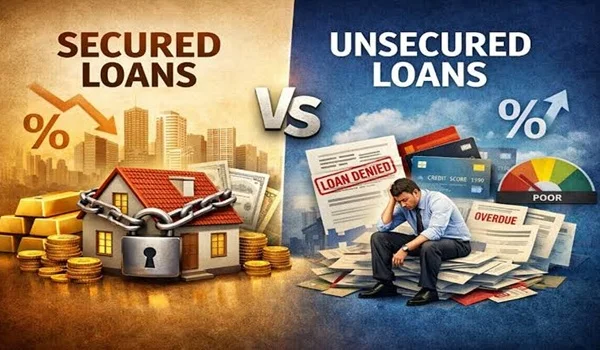
Loans can broadly be divided into two categories based on whether the lender requires an asset as security: secured loans and unsecured loans.
A secured loan is backed by collateral such as a house, property, vehicle, gold or eligible securities. An unsecured loan does not generally require a specific asset to be pledged. Instead, the lender primarily evaluates the borrower’s credit profile, income, repayment capacity and other relevant factors.
Both types of loans can help individuals and businesses access funds, but they differ in terms of collateral, eligibility, risk, interest rates, loan amounts, documentation and consequences of default.
Understanding these differences is important before borrowing money.
What Is a Secured Loan?
A secured loan is a loan backed by an asset that is offered as security to the lender.
The asset is known as collateral.
Common examples include:
- Home loans
- Loans against property
- Gold loans
- Many vehicle loans
- Loans against securities
- Certain business loans backed by property or other assets
For example, if a person takes a loan against property, the property may be pledged as security. If the borrower does not meet the repayment obligations, the lender may have rights to enforce the security subject to the loan agreement and applicable law.
Collateral gives the lender an additional source of security beyond the borrower’s promise to repay.
What Is an Unsecured Loan?
An unsecured loan is a loan that generally does not require the borrower to pledge a specific asset as collateral.
Examples include:
- Personal loans
- Some business loans
- Certain consumer loans
- Some short-term credit facilities
Because there is no specific asset securing the loan, lenders may place greater emphasis on the borrower’s:
- Income
- Credit history
- Existing debt
- Employment or business profile
- Banking history
- Repayment capacity
- Other underwriting factors
Approval is therefore based significantly on the borrower’s overall creditworthiness.
Secured vs Unsecured Loans: Quick Comparison
| Feature | Secured Loan | Unsecured Loan |
| Collateral | Generally required | Generally not required |
| Examples | Home loan, gold loan, loan against property | Personal loan, some business loans |
| Lender’s security | Specific asset | Primarily borrower’s creditworthiness and contractual repayment obligation |
| Loan amount | Can be relatively high depending on collateral and eligibility | Depends heavily on income, credit profile and lender policy |
| Interest rate | Depends on product and borrower | Often reflects the higher risk to lender |
| Documentation | May include asset-related documents | Primarily borrower and income/credit documents |
| Approval | May involve collateral valuation | Primarily credit and income assessment |
| Default risk | Secured asset may be subject to enforcement | No specific pledged asset, but default can affect credit and lead to recovery action |
| Processing | May involve legal/valuation checks | Can be comparatively simpler for some products |
| Typical tenure | Varies; some secured loans have long tenures | Often shorter, but varies by product |
The table provides a broad comparison. Actual terms differ between lenders and loan products.
How Does a Secured Loan Work?
The process generally works as follows:
Step 1: Apply for the loan
The borrower applies for a specific secured loan and provides financial and personal information.
Step 2: Submit collateral details
The borrower provides information and documents relating to the asset being offered as security.
Step 3: Lender evaluates the borrower and asset
The lender assesses both:
- The borrower’s repayment capacity
- The value and suitability of the collateral
For property-backed loans, this can involve legal and technical evaluation of the property.
Step 4: Loan is sanctioned
If the application meets the lender’s requirements, the lender sanctions the loan subject to its terms.
Step 5: Security is created
The lender obtains the applicable security interest or other legally recognised security arrangement over the asset.
Step 6: Loan is disbursed
After completion of the required formalities, the loan is disbursed.
Step 7: Borrower repays
The borrower makes repayments according to the agreed schedule.
After the loan is fully repaid, the lender must complete the applicable release of security and documentation. RBI’s regulatory framework includes requirements concerning the release of original movable or immovable property documents after full repayment or settlement of applicable loan accounts.
How Does an Unsecured Loan Work?
The process for an unsecured loan is generally more focused on the borrower’s financial and credit profile.
The lender may examine:
- Income
- Employment
- Business income
- Credit history
- Existing EMIs
- Bank account activity
- Debt obligations
- Age
- Loan amount requested
If the lender is satisfied with the applicant’s repayment capacity and other eligibility conditions, it may approve the loan without requiring a specific asset as collateral.
Examples of Secured Loans
Home Loan
A home loan is generally secured against the residential property being financed.
The borrower repays the loan through the agreed repayment schedule, commonly through EMIs.
Gold Loan
A gold loan is secured against eligible gold pledged with the lender.
The lender assesses the gold and provides financing according to its applicable terms and regulatory requirements.
Loan Against Property
A borrower can raise funds by offering eligible residential or commercial property as security.
The funds may be used for permitted personal or business requirements, depending on the product.
Vehicle Loan
Many vehicle loans involve the vehicle being financed as security for the lender.
The exact legal and documentation structure depends on the lender and financing arrangement.
Loan Against Securities
Eligible investments such as certain shares, bonds or mutual fund units can be pledged to obtain financing, subject to the lender’s eligibility requirements.
Examples of Unsecured Loans
Personal Loan
A personal loan is one of the most common examples of unsecured borrowing.
The borrower generally does not pledge a specific property, vehicle or investment. Instead, the lender evaluates the applicant’s creditworthiness and repayment capacity.
Some Business Loans
Some business loan products may be offered without specific collateral, particularly where the borrower meets the lender’s eligibility and underwriting requirements.
Consumer Finance
Certain financing arrangements for consumer purchases may also be unsecured, depending on the lender and product structure.
Why Are Secured Loans Often Associated With Lower Interest Rates?
A secured loan gives the lender a specific asset as additional security.
If the borrower defaults, the lender may have rights over that collateral under the applicable agreement and legal process.
This can reduce the lender’s credit risk compared with an otherwise similar unsecured loan.
However, it would be incorrect to assume that every secured loan always has a lower interest rate than every unsecured loan.
Interest rates depend on many factors, including:
- Type of loan
- Borrower’s credit profile
- Loan amount
- Tenure
- Collateral
- Lender’s pricing
- Market conditions
- Risk assessment
Therefore, borrowers should compare the actual offers rather than relying only on the secured/unsecured classification.
Why Can Unsecured Loans Be More Expensive?
With an unsecured loan, the lender does not generally have a specific pledged asset that can provide additional security.
The lender therefore relies more heavily on the borrower’s ability and willingness to repay.
This additional credit risk can be reflected in the pricing of some unsecured products.
For example, a personal loan may carry a different interest rate from a secured property-backed loan for the same borrower.
However, the actual rate depends on the lender and the borrower’s profile.
Secured vs Unsecured Loans: Difference in Risk
The two types of loans create different risks.
Borrower’s perspective
With a secured loan, failure to repay can put the pledged asset at risk, subject to applicable law and recovery procedures.
For example, a borrower who defaults on a secured property loan may ultimately face enforcement against the property.
With an unsecured loan, there is no specific collateral pledged under the loan. However, default can still result in:
- Overdue amounts
- Applicable charges
- Negative credit reporting
- Recovery action
- Legal proceedings where applicable
Therefore, an unsecured loan does not mean risk-free borrowing.
Difference in Loan Amount
Secured loans can sometimes provide access to larger amounts because the lender has collateral supporting the facility.
For example, the borrowing capacity under a loan against property may depend partly on the value and eligibility of the property.
Unsecured loans are generally constrained more directly by factors such as income, credit history and repayment capacity.
However, there is no universal maximum amount for either category. Each lender sets its own product limits and eligibility conditions.
Difference in Loan Tenure
Secured loans can often have longer repayment periods, particularly products such as home loans.
Unsecured loans may have shorter repayment periods, although the actual tenure varies significantly by product and lender.
A longer tenure can reduce the periodic EMI but may increase the total interest paid over the life of the loan.
Therefore, borrowers should consider both:
Monthly affordability + Total repayment cost
Difference in Documentation
Secured loans may require two categories of documentation:
- Borrower-related documents
- Collateral-related documents
For example, a property-backed loan may require property ownership documents and legal/technical verification in addition to income and identity documents.
Unsecured loans generally do not require collateral documents, which can make the application process simpler for some borrowers.
However, the lender can still request income, employment, banking and other documents.
Difference in Approval Process
Secured loan approval may involve additional steps because the lender has to evaluate the collateral.
This can include:
- Property valuation
- Legal verification
- Gold valuation
- Security documentation
- Verification of ownership
- Other asset-related checks
Unsecured loans may avoid these collateral-related steps, although lenders still conduct credit and income assessment.
What Happens If You Default?
Default means failing to make repayments according to the loan agreement.
In a secured loan
The lender can take steps available under the loan agreement and applicable law to recover the outstanding amount, including enforcement of the security where legally permitted.
The specific process depends on the type of collateral and applicable recovery framework.
In an unsecured loan
There is no specific pledged asset to enforce against, but the lender can still pursue recovery according to the agreement and applicable law.
Default can also affect the borrower’s credit history.
Therefore, borrowers should not assume that unsecured borrowing has no serious consequences.
Secured vs Unsecured Loans and Credit Score
Both types of borrowing can affect your credit history.
For example, consistently paying EMIs on time can contribute to a positive repayment record, while missed or overdue payments can negatively affect credit information.
The presence or absence of collateral does not remove the importance of responsible repayment.
Before taking another loan, borrowers should also consider their existing debt obligations.
Which Is Easier to Get?
There is no universal answer.
An unsecured loan may have a simpler documentation process because there is no collateral to evaluate.
However, the lender may have strict requirements relating to income, credit history and repayment capacity.
A secured loan may be accessible to a borrower who has suitable collateral but does not qualify for an unsecured loan on the same terms.
For example, a borrower with valuable eligible property may be able to seek a property-backed loan even if an unsecured lender would offer a smaller amount.
When Can a Secured Loan Be Useful?
A secured loan can be relevant when:
- You need a relatively large amount
- You have suitable collateral
- You want a longer repayment period
- The purpose fits a secured loan product
- You are comfortable pledging an asset
- The overall borrowing cost is suitable
The borrower must be comfortable with the consequences of putting an asset at risk.
When Can an Unsecured Loan Be Useful?
An unsecured loan can be relevant when:
- You need funds without pledging an asset
- You meet the lender’s credit and income requirements
- You need a relatively straightforward application
- The loan amount is within your repayment capacity
- The total borrowing cost is acceptable
The convenience of not providing collateral should be weighed against the interest rate and other charges.
How to Compare Secured and Unsecured Loans
Do not compare loans only by whether they require collateral.
Check:
- Interest rate
- Annual Percentage Rate (where applicable)
- Processing fee
- Other charges
- Loan tenure
- EMI
- Total repayment amount
- Prepayment or foreclosure conditions
- Default provisions
- Collateral requirements
- Documentation
- Disbursal conditions
For regulated lenders, RBI’s framework provides for a Key Facts Statement (KFS) for applicable retail and MSME term loans, containing important information such as loan amount, tenure, interest type and applicable charges.
The KFS can therefore be useful when comparing the actual cost and terms of eligible loan products.
Example: Secured vs Unsecured Loan
Suppose Priya needs ₹8 lakh for a financial requirement.
She has two possible borrowing routes:
Option A: Secured loan
She offers an eligible asset as collateral. The lender evaluates the asset and her repayment capacity before sanctioning the loan.
Option B: Unsecured loan
She does not pledge an asset. Instead, the lender evaluates her income, credit profile, existing obligations and other eligibility factors.
The two loans may have different interest rates, tenures, fees and repayment structures.
Priya should compare the complete terms and also consider whether she is comfortable putting an asset at risk.
Key Advantages and Limitations
Secured Loans
Potential advantages:
- Can provide access to larger financing in some cases
- May offer longer repayment periods for certain products
- Collateral can strengthen the loan application
- Some secured products may have comparatively lower pricing
Potential limitations:
- Requires eligible collateral
- Asset valuation and verification may take additional time
- The pledged asset can be exposed to enforcement if the borrower defaults
- Documentation can be more extensive
Unsecured Loans
Potential advantages:
- No specific collateral is generally required
- Application can be simpler for eligible borrowers
- Useful when the borrower does not own suitable collateral
- Can provide relatively quick access to funds for some products
Potential limitations:
- Interest rates can be higher for some products
- Loan amounts may be more restricted by income and credit profile
- Tenures can be shorter for certain products
- Default can damage credit history and result in recovery action
Frequently Asked Questions
What is the main difference between secured and unsecured loans?
The main difference is collateral. A secured loan is backed by an asset pledged as security, while an unsecured loan generally does not require a specific asset as collateral.
Is a home loan secured or unsecured?
A standard home loan is generally a secured loan because the property provides security to the lender.
Is a personal loan secured or unsecured?
A typical personal loan is unsecured, although the exact structure depends on the lender and product.
Is a gold loan secured?
Yes. A gold loan is secured by eligible gold pledged with the lender.
Are secured loans always cheaper?
Not necessarily. Secured loans can have lower pricing in some circumstances because collateral reduces lender risk, but the actual rate depends on the product, lender and borrower profile.
Can an unsecured loan have a lower interest rate than a secured loan?
It can happen depending on the products and borrower circumstances. Interest rates should be compared based on actual offers rather than the loan category alone.
Can I get a secured loan with a low credit score?
It depends on the lender, collateral, income, repayment capacity and other underwriting factors. Collateral does not automatically guarantee approval.
Does an unsecured loan require a credit score?
Lenders may consider credit history and other factors when assessing an unsecured loan application. Requirements vary between lenders.
What happens to collateral if I repay a secured loan?
After all applicable obligations are satisfied, the lender should release the security and complete the relevant documentation according to the loan arrangement and applicable rules. RBI’s framework includes requirements regarding release of original movable and immovable property documents after full repayment or settlement of applicable loans.
Which type of loan should I choose?
The choice depends on the borrowing purpose, amount required, repayment capacity, available collateral, interest rate, tenure and overall loan cost. A borrower should compare the actual terms rather than choosing solely based on whether a loan is secured or unsecured.
Conclusion
The fundamental difference between secured and unsecured loans is the presence of collateral.
A secured loan uses an asset such as property, gold, a vehicle or eligible securities as security for the lender. An unsecured loan generally relies on the borrower’s creditworthiness and repayment capacity without requiring a specific pledged asset.
Secured loans can provide access to larger amounts or longer tenures in certain situations, while unsecured loans can offer borrowing without putting a specific asset up as collateral. At the same time, both types carry repayment obligations, and default can have significant financial consequences.
Before borrowing, compare the interest rate, total cost, EMI, tenure, fees, repayment conditions and consequences of default. For applicable loans, review the lender’s Key Facts Statement and loan agreement carefully so that you understand the complete cost and obligations before accepting the facility.