Buying your first home is a major financial decision. For a first-time buyer, the process can feel complicated because it involves choosing a location, comparing properties, arranging a down payment, applying for a home loan, checking legal documents, paying stamp duty and registration charges, and finally taking possession.
A first home should not be selected only because the property looks attractive or the builder offers a discount. You need to consider whether the property is legally clear, financially affordable and suitable for your long-term needs.
This first-time home buyer guide in India explains the process step by step, including budgeting, home loans, property verification, RERA, taxes, government housing support and common mistakes to avoid.
Quick Overview: First-Time Home Buying Process
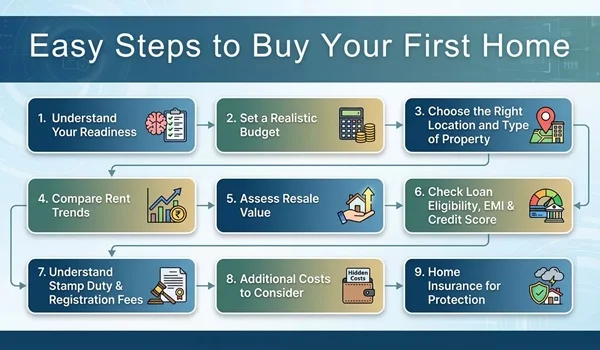
| Step | What to Do |
| 1 | Define your home-buying requirements |
| 2 | Calculate your total budget |
| 3 | Build your down payment and emergency fund |
| 4 | Check home-loan eligibility |
| 5 | Select the location |
| 6 | Compare properties |
| 7 | Verify the builder/seller and property documents |
| 8 | Check RERA registration where applicable |
| 9 | Compare home-loan offers |
| 10 | Negotiate the property price |
| 11 | Sign the agreement |
| 12 | Pay applicable stamp duty and registration charges |
| 13 | Register the sale deed |
| 14 | Complete possession and post-purchase formalities |
- Decide What You Need in Your First Home
Before looking at properties, make a list of your requirements.
Consider:
- 1 BHK, 2 BHK, 3 BHK or another configuration
- Apartment, independent house or villa
- Ready-to-move or under-construction
- Preferred location
- Distance from workplace
- Public transport
- Schools and hospitals
- Parking requirements
- Family size
- Future family requirements
- Security
- Maintenance costs
- Access to markets and daily services
Avoid buying a larger property simply because you qualify for a larger loan.
A first home should fit your current finances as well as your future financial commitments.
- Calculate Your Real Home-Buying Budget
One of the biggest mistakes first-time buyers make is treating the property price as the total cost.
Your actual budget may include:
- Down payment
- Home loan
- Stamp duty
- Registration charges
- Brokerage, if applicable
- Legal verification
- Loan-related charges
- GST, where applicable
- Maintenance or corpus charges
- Parking charges, where applicable
- Interior work
- Furniture
- Moving expenses
- Utility deposits
- Society-related charges
Stamp duty and registration costs vary by state and transaction.
Therefore, if you see a home advertised at ₹60 lakh, do not assume that your total expenditure will be exactly ₹60 lakh.
A Simple Budget Formula
Total home-buying budget = Property price + transaction costs + initial setup costs
Keeping a separate emergency fund is also important. Do not use every rupee of your savings for the down payment.
- Keep Money for the Down Payment
Home loans generally do not finance the entire property cost.
The amount you need to contribute from your own funds depends on the lender, property value, applicable lending rules and the loan structure.
RBI’s housing-finance framework includes loan-to-value limits for regulated lenders, meaning buyers should expect to contribute part of the property cost themselves rather than assuming 100% financing.
For example, if you plan to purchase a ₹70 lakh property, you may need substantial upfront funds depending on the loan amount sanctioned.
But your down payment is not your only upfront requirement.
You should separately budget for:
Down payment + stamp duty + registration + other purchase expenses + emergency reserve
- Do Not Empty Your Savings for the House
Buying a home can create a large financial commitment.
Before using your savings for the down payment, keep enough money for:
- Emergency expenses
- Medical or family requirements
- Job interruption
- Existing loan obligations
- Insurance premiums
- Home repairs
- Immediate household expenses
A common mistake is to become “house rich but cash poor” — owning a property while having very little liquid money left.
- Check Your Home-Loan Eligibility
Home-loan eligibility depends on the lender’s assessment of your repayment capacity and other factors.
RBI guidance notes that lenders consider factors such as monthly disposable or surplus income, expenses, spouse’s income, assets, liabilities and income stability when assessing housing-loan eligibility.
Lenders may also consider:
- Age
- Employment history
- Business stability
- Existing EMIs
- Credit history
- Credit score
- Income
- Requested loan amount
- Property value
- Loan tenure
There is no single home-loan eligibility formula that applies identically to every lender.
- Check Your Credit Profile Before Applying
Your credit history can affect how a lender evaluates your loan application.
Before applying for a home loan:
- Check your credit report.
- Look for incorrect account information.
- Check for overdue payments.
- Review existing loans and credit cards.
- Avoid unnecessary new credit applications.
- Clear genuine overdue amounts before applying.
A good credit profile can strengthen your application, but it does not guarantee loan approval.
- Compare Home-Loan Offers Properly
Do not compare lenders only by looking at the advertised interest rate.
Check:
- Interest rate
- Fixed or floating structure
- Processing fee
- Legal and technical charges
- Other applicable fees
- Prepayment/foreclosure terms
- Conversion charges
- Reset mechanism
- EMI
- Loan tenure
- Total repayment
- APR where applicable
- Conditions attached to the loan
RBI guidance requires key loan information and applicable charges to be disclosed through the Key Facts Statement framework for covered loans. RBI also highlights the importance of understanding the effect of interest-rate changes on floating-rate loans.
Fixed vs Floating Home Loan
A floating-rate loan can change when the relevant benchmark or reference rate changes.
This means your EMI, tenure or both may change depending on the lender’s applicable mechanism.
Before accepting a floating-rate loan, understand:
- Which benchmark is used
- How often the rate is reset
- How the reset affects EMI or tenure
- What happens if rates increase
- Whether applicable options exist for managing a higher EMI or longer tenure
- Choose the Location Before Choosing the House
For a first home, location is often as important as the property itself.
Check:
- Road connectivity
- Metro or public transport
- Traffic
- Schools
- Hospitals
- Markets
- Offices and employment centres
- Water supply
- Electricity
- Drainage
- Internet connectivity
- Parking
- Security
- Noise
- Pollution
- Future infrastructure
- Flooding or waterlogging history
Visit the location at different times of the day.
A neighbourhood may feel peaceful in the afternoon but become heavily congested during office hours.
- Compare Ready-to-Move and Under-Construction Homes
Ready-to-Move Home
Advantages may include:
- Physical inspection of the finished property
- Immediate or relatively quicker possession, subject to required formalities
- Ability to assess actual construction quality
- Better visibility of the surrounding area
Check applicable completion and occupancy-related documents before possession.
Under-Construction Home
An under-construction property requires additional checks.
Review:
- Builder’s track record
- RERA registration where applicable
- Approved plans
- Project specifications
- Construction progress
- Proposed completion date
- Project disclosures
- Payment schedule
- Agreement terms
RERA’s official FAQs explain that registered project information includes matters such as project completion period and other project details, while registration validity is linked to the completion period declared by the promoter, subject to the Act.
- Check RERA Before Booking an Applicable Project
The Real Estate (Regulation and Development) Act, 2016 created a regulatory framework intended to improve transparency and protect homebuyers.
For a project covered by RERA, check the relevant state or UT RERA website before booking.
Look for:
- RERA registration number
- Promoter name
- Project address
- Approved plans
- Project status
- Completion timeline
- Number of units
- Carpet area
- Project disclosures
- Regulatory updates
Do not rely only on the builder’s brochure.
Also remember that RERA has statutory exemptions, so the absence of a RERA registration number does not automatically mean that a property is illegal. The project’s applicability should be checked against the Act and relevant state rules.
- Understand Carpet Area
First-time buyers should pay close attention to carpet area when comparing apartments.
Do not compare homes solely by the advertised “saleable area” or other marketing terminology.
Ask the seller or builder to clearly provide:
- Carpet area
- Configuration
- Balcony/terrace area where relevant
- Common-area information
- Parking details
Two flats with similar quoted prices can provide significantly different usable space.
- Verify the Property Documents
This is one of the most important steps.
For a resale property, ask for relevant documents such as:
- Current sale deed
- Previous title documents
- Chain of ownership
- Encumbrance-related records
- Property tax receipts
- Approved building plan
- Completion certificate, where applicable
- Occupancy certificate, where applicable
- Mutation records
- Society documents
- Share certificate, where applicable
- No-dues certificate, where applicable
- Existing loan closure documents, if applicable
The exact requirements vary by state and property type.
A property lawyer should review the title and documents before you make a substantial financial commitment.
- Verify the Seller’s Ownership
The person selling the property should have the legal authority to sell it.
Pay special attention when the property involves:
- Inheritance
- Multiple owners
- Joint ownership
- Power of attorney
- Company ownership
- Trusts
- Family settlements
- Previous mortgages
- Court disputes
Do not rely on a verbal statement that “everything is clear.”
Ownership and authority should be supported by appropriate documents.
- Check Existing Property Dues
Before completing a resale purchase, check whether there are outstanding:
- Property taxes
- Maintenance charges
- Electricity bills
- Water charges
- Society dues
- Loan liabilities
- Other property-related payments
The agreement should clearly state who is responsible for outstanding amounts up to the relevant date.
- Inspect the House Physically
Never buy your first home solely from photographs.
During a property inspection, check:
- Walls
- Ceiling
- Flooring
- Doors
- Windows
- Plumbing
- Electrical points
- Water pressure
- Ventilation
- Natural light
- Seepage
- Dampness
- Lift
- Parking
- Fire-safety arrangements
- Common areas
- Security
- Mobile network
- Noise levels
For an under-construction property, compare the actual construction and specifications with the contractual documents.
- Understand All Additional Charges
Before paying a booking amount, ask for a complete cost sheet.
| Cost | What to Check |
| Basic property price | Final agreed price |
| Parking | Included or additional |
| Floor-rise charge | Applicable or not |
| Maintenance | One-time/recurring |
| Corpus fund | Applicable amount |
| Club/facility charges | Whether applicable |
| Stamp duty | State-specific |
| Registration | State-specific |
| GST | Applicable depending on transaction/property status |
| Brokerage | If applicable |
| Loan charges | Lender-specific |
| Interior work | Your own estimate |
This prevents surprises after booking.
- Negotiate More Than Just the Price
As a first-time buyer, you may focus entirely on reducing the property price.
But other terms can also matter.
Discuss:
- Payment schedule
- Possession date
- Parking
- Fixtures
- Maintenance
- Repairs
- Existing dues
- Cancellation terms
- Default provisions
- Documentation
- Handover conditions
Make important promises part of the written agreement rather than relying on sales conversations.
- Sign the Agreement Carefully
Before signing an agreement to sell or builder-buyer agreement, understand:
- Property description
- Carpet area
- Total consideration
- Payment schedule
- Booking amount
- Possession terms
- Default clauses
- Cancellation provisions
- Refund conditions
- Maintenance responsibility
- Parking rights
- Other charges
- Construction/possession obligations
For a significant purchase, have an independent property lawyer review the agreement.
- Understand Stamp Duty and Registration
Stamp duty and registration charges can add a significant amount to your purchase cost.
They are primarily governed by applicable state laws, so there is no single nationwide rate that every homebuyer can use.
Before finalising your budget, check the official registration department of the relevant state.
Do not calculate your total purchase cost using a rate found on an old property website.
- Understand Home-Loan Tax Benefits
Tax benefits depend on the tax regime, property type, loan purpose, loan date and other conditions.
For the old tax regime, the Income Tax Department currently states that eligible interest on a housing loan for a self-occupied property can qualify for a deduction under Section 24(b), with a ₹2 lakh upper limit subject to the applicable conditions. It also lists eligible housing-loan principal payments under Section 80C within the combined ₹1.5 lakh limit.
However, first-time buyers should not assume that a special “first home” deduction is currently available simply because they are buying their first property.
For example, Section 80EEA relates to loans sanctioned between 1 April 2019 and 31 March 2022, subject to its other conditions. It is therefore not a general new benefit available to every first-time buyer in 2026.
Tax treatment under the new tax regime is different, so compare your actual tax position rather than assuming that every home-loan payment will produce a deduction.
- Check Government Housing Schemes
Eligible first-time or first-house buyers in urban areas should also check whether they qualify for current government housing assistance.
Under PMAY-U 2.0, families in eligible urban areas with no pucca house anywhere in India can potentially qualify, subject to the scheme’s conditions. The guidelines classify EWS, LIG and MIG households using specified income bands, currently up to ₹3 lakh, ₹3–6 lakh and ₹6–9 lakh respectively, with provisions allowing states/UTs certain flexibility regarding EWS income criteria.
The scheme also contains conditions relating to previous housing assistance and other eligibility requirements.
Therefore, do not assume that every first-time buyer automatically receives a government subsidy.
Check the current official scheme guidelines and your state/ULB implementation details before including any subsidy in your financial plan.
- Plan Your EMI Carefully
The EMI should fit comfortably within your monthly finances.
Suppose you take a home loan of ₹50 lakh. A longer tenure may reduce the monthly EMI, but it can increase the total interest paid over the life of the loan.
Therefore, compare:
- Loan amount
- Interest rate
- Tenure
- EMI
- Total interest
- Total repayment
Illustrative Example
Suppose a ₹50 lakh home loan is taken at an assumed 8.5% annual interest rate.
For illustration:
- 20-year tenure: EMI is approximately ₹43,391
- 25-year tenure: EMI is approximately ₹40,263
- 30-year tenure: EMI is approximately ₹38,446
These figures are only mathematical illustrations, not current market loan offers. The actual rate, EMI and charges will depend on the lender and loan terms.
The lower EMI of a longer tenure should always be weighed against the higher total interest cost.
- Consider Your Future Expenses
A home loan can continue for many years.
Before buying, think about:
- Marriage
- Children
- Education expenses
- Parents’ needs
- Car purchase
- Existing loans
- Retirement savings
- Insurance
- Career changes
- Possible relocation
A property that is affordable today may become difficult to maintain if your expenses rise significantly.
- Keep an Emergency Fund After Buying
Do not spend all your savings on the down payment and property-related costs.
After buying the home, you may suddenly face expenses for:
- Furniture
- Appliances
- Repairs
- Registration-related formalities
- Moving
- Maintenance
- Renovation
- Insurance
- Unexpected household expenses
Maintaining an emergency reserve can make the transition into homeownership more manageable.
- Understand Possession and Handover
Before accepting possession, inspect the property.
Check:
- Flat/house condition
- Fixtures
- Keys
- Parking
- Electricity meter
- Water connection
- Maintenance dues
- Possession documents
- Applicable completion/occupancy documentation
- Defects or pending work
Record defects in writing and retain copies of relevant communications.
- Complete Post-Purchase Formalities
Registration may not be the end of the process.
Depending on the property and state, you may need to complete:
- Mutation
- Municipal record update
- Society membership transfer
- Share certificate transfer
- Electricity name change
- Water connection name change
- Property-tax record update
- Loan-related documentation
Keep the registered sale deed and other original documents safely.
Documents First-Time Buyers Should Keep Ready
Buyer Documents
Common documents may include:
- PAN
- Aadhaar or other accepted identity proof
- Address proof
- Photographs
- Bank statements
- Salary slips
- Form 16
- Income-tax returns
- Business/financial documents for self-employed applicants
- Existing loan statements
The exact list depends on the lender and transaction.
Property Documents
Depending on the property:
- Sale deed
- Previous title deeds
- Encumbrance-related documents
- Approved plan
- RERA registration details
- Completion certificate
- Occupancy certificate
- Property-tax receipts
- Mutation documents
- Society documents
- No-dues certificate
- Loan closure documents
- Possession documents
First-Time Home Buyer Mistakes to Avoid
- Buying at the Maximum Loan Eligibility
The amount a lender is willing to lend is not necessarily the amount you should borrow.
- Ignoring Additional Costs
A ₹60 lakh property can require substantially more than ₹60 lakh when all applicable transaction and setup costs are included.
- Using All Your Savings
Keep an emergency reserve.
- Choosing a Home Only Because of a Discount
A discount does not compensate for poor location, weak documentation or unsuitable construction.
- Skipping Legal Verification
Never assume the builder, seller or broker’s document review is sufficient.
- Not Checking RERA
For applicable projects, verify the project’s official RERA record.
- Ignoring the Carpet Area
Compare usable space rather than relying entirely on marketing area figures.
- Choosing the Longest Tenure Without Comparing Total Interest
A lower EMI can mean a higher total repayment.
- Depending on Verbal Promises
Get important commitments in writing.
- Forgetting Future Expenses
Your first home should not consume all your future financial flexibility.
First-Time Home Buyer Checklist
Before booking:
- I have calculated my complete budget.
- I have a separate emergency fund.
- I know how much down payment I can afford.
- I have checked my credit profile.
- I have compared home-loan offers.
- I have shortlisted suitable locations.
- I have physically inspected the property.
- I have checked the builder/seller.
- I have verified ownership/title.
- I have checked applicable RERA registration.
- I have checked property dues.
- I understand carpet area.
- I have obtained a complete cost sheet.
- I understand the agreement.
- I have checked stamp duty and registration costs.
- I have checked applicable tax implications.
- I have investigated government housing schemes if potentially eligible.
- I have reviewed the loan’s KFS and applicable charges.
- I have planned possession and post-registration formalities.
First-Time Home Buyer: Example
Suppose a young couple wants to buy their first apartment for ₹70 lakh.
Instead of immediately booking the property, they can follow this sequence:
Step 1: Calculate their combined income and existing EMIs.
Step 2: Determine how much down payment they can comfortably make without exhausting their savings.
Step 3: Keep an emergency reserve.
Step 4: Compare home-loan offers and understand interest rate, tenure, EMI, charges and applicable KFS information.
Step 5: Shortlist locations based on work, transport, schools and family requirements.
Step 6: Compare several properties rather than choosing the first one they see.
Step 7: Verify the seller or builder, title, approvals and RERA details where applicable.
Step 8: Obtain a complete cost sheet.
Step 9: Have the agreement reviewed before signing.
Step 10: Complete applicable stamp duty and registration formalities.
This approach helps separate the emotional decision of choosing a home from the financial and legal decision of buying the property.
Frequently Asked Questions
Who is considered a first-time home buyer?
Generally, the term refers to someone purchasing a residential property for the first time. However, the definition can differ for specific government schemes or tax provisions. Always check the conditions applicable to the particular benefit you are considering.
How much money should I save before buying my first home?
There is no universal amount. You should plan for the down payment, applicable stamp duty and registration, other transaction expenses, initial setup costs and an emergency reserve.
Can a first-time buyer get a home loan?
Yes, first-time buyers can apply for home loans if they meet the lender’s eligibility requirements. Approval depends on factors such as income, repayment capacity, credit history, existing liabilities and property details.
Is a 20-year or 30-year home loan better?
Neither is universally better. A longer tenure can reduce the EMI but generally increases the total interest paid, while a shorter tenure can increase the EMI but reduce the repayment period.
Does a good credit score guarantee a home loan?
No. A strong credit profile can help, but lenders consider income, repayment capacity, existing obligations, employment/business stability and property-related factors as well.
Should I buy a ready-to-move or under-construction house?
It depends on your requirements and risk tolerance. A ready property can be physically inspected, while an under-construction property requires careful review of project approvals, RERA information, construction progress and contractual terms.
Is RERA compulsory for every property?
No. The RERA framework contains exemptions and applicability depends on the project and circumstances. For an applicable project, check the relevant state or UT RERA authority.
Can I get a government subsidy for my first home?
Potentially, if you meet the requirements of an applicable housing scheme. PMAY-U 2.0, for example, has specific income, ownership and other eligibility conditions. Being a first-time buyer alone does not guarantee assistance.
Are home-loan tax benefits available under the new tax regime?
Tax treatment differs between the old and new regimes. The Income Tax Department’s current guidance should be checked for the relevant assessment year and property circumstances.
Do I need a property lawyer?
For a significant property purchase, independent legal review is highly useful, particularly for verifying title, ownership history, encumbrances, approvals and agreements.
Key Takeaways
Buying your first home in India is not simply about finding a property you like. It is a combination of financial planning, property selection, legal verification and long-term affordability.
The basic process is:
Set your budget → save for down payment → maintain emergency funds → check loan eligibility → choose location → compare properties → verify documents → check RERA where applicable → compare loans → negotiate → sign the agreement → pay applicable charges → register the property → inspect possession → complete post-purchase formalities.
The most important lesson for a first-time buyer is to avoid rushing into a purchase because of a limited-time offer, sales pressure or fear of rising prices.
A home is a long-term financial commitment. Take time to understand the total cost, EMI, property documents, ownership, approvals, taxes and future expenses before signing the final agreement.