If you have filed or are involved in a court case but do not remember the case number, you may be able to find it online. The Indian e-Courts system provides several search options that can help locate a case using information such as the party name, CNR number, filing number, advocate name, FIR number, Act or case type.
A case number is useful for checking the current status, hearing history, orders and other case-related information. However, the case number and CNR number are different identifiers, so it is important to know what information you already have before starting the search.
This guide explains how to find your case number online through official court services in India.
What Is a Court Case Number?
A case number is the registration number assigned to a case by the court.
It is generally used together with the case type and registration year.
For example, a case may be displayed in a format such as:
Civil Suit No. 125/2024
or
Criminal Case No. 78/2023
The exact format varies between courts and types of proceedings.
The e-Courts High Court service provides a dedicated Case Number search in which users select the case type, enter the case registration number and year, and then view the matching case.
Case Number vs CNR Number
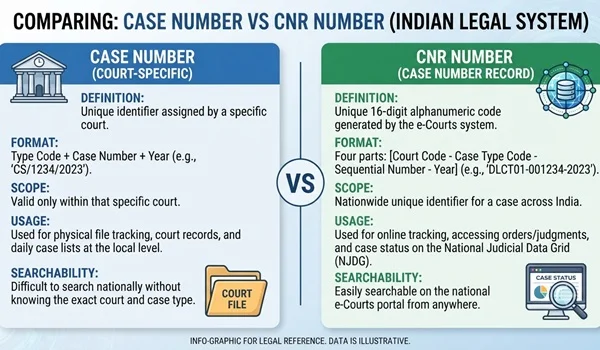
These two terms are often confused.
| Detail | Case Number | CNR Number |
| Meaning | Registration number of the case | Unique case identifier used in e-Courts |
| Format | Varies by case type/court | 16-character alphanumeric format |
| Usually requires | Case type + number + year | CNR itself |
| Used for online search | Yes | Yes |
| Can identify case history | Yes | Yes |
| Search available through e-Courts | Yes | Yes |
The official e-Courts service states that a CNR is a 16-character alphanumeric number, while case-number searches require the relevant case type, registration number and year.
How to Find Your Case Number Online
If you do not know the case number, you can try finding the case through another identifier.
The main options are:
- Search by CNR number
- Search by party name
- Search by filing number
- Search by advocate name
- Search by FIR number
- Search by Act
- Search by case type
These options are available through e-Courts services, although the exact search interface can differ between court services.
Method 1: Find Your Case Number Using CNR Number
If you know your CNR number, this is one of the easiest ways to locate the case.
The official e-Courts service instructs users to enter the 16-character CNR without spaces or hyphens. The resulting page can show the current status and case history.
Steps
- Open the official e-Courts case-status service.
- Select the appropriate court service.
- Choose the CNR Number search option.
- Enter the CNR.
- Complete the captcha.
- Click Search.
- Open the case details.
The case details can reveal the registered case number along with other information.
Method 2: Find Your Case Number by Party Name
If you do not know your CNR or case number, searching by party name can be useful.
The party could be:
- Plaintiff
- Defendant
- Petitioner
- Respondent
- Complainant
- Accused
- Appellant
- Other party
The official High Court e-Courts service allows users to search using part or all of a party name. Its instructions specify that at least three characters can be used in the party-name search.
Steps
- Open the relevant e-Courts service.
- Select Case Status.
- Choose Party Name.
- Enter the person’s or organisation’s name.
- Enter the registration year if required.
- Select Pending, Disposed or Both, where applicable.
- Enter the captcha.
- Click Search.
- Review the list of matching cases.
- Open the relevant case.
The results can provide the case number and other identifying information.
Example
Suppose you know that Ramesh Kumar is a party to a case but you do not know the case number.
You could search:
Party Name: Ramesh Kumar
Year: 2024
If multiple cases appear, compare:
- Opposite party
- Court
- Case type
- Registration year
- Case status
This helps identify the correct matter.
Method 3: Find Your Case Number Using Filing Number
A filing number is another useful identifier.
A filing number may be assigned in connection with the filing of a matter before it is reflected as a registered case in the court’s case-management system.
The official e-Courts system provides a Filing Number search option for case-status searches.
Steps
- Open the relevant e-Courts case-status service.
- Select Filing Number.
- Enter the filing number.
- Enter the relevant year.
- Provide other required information.
- Complete the captcha.
- Search for the matter.
- Open the matching record.
If the filing has been registered as a case, the resulting information can help you identify the registered case number.
Method 4: Find Your Case Number Through Your Advocate’s Name
If you know the lawyer handling your case but do not have the case number, the Advocate Name search may help.
The official High Court e-Courts service provides searches based on advocate name and also offers advocate-related search options such as Bar Registration Number and advocate cause-list searches.
Steps
- Select the relevant High Court and bench.
- Open Case Status.
- Select Advocate Name.
- Enter the advocate’s name or other available advocate information.
- Search the results.
- Identify the case involving you.
- Note the case number and CNR.
This method may produce several results if the advocate handles many cases.
Method 5: Find a Criminal Case Number Using an FIR Number
If your matter is connected with a police FIR, the FIR Number may help you locate the corresponding court case.
The official High Court e-Courts service provides an FIR search requiring information such as:
- Police station
- FIR number
- FIR year
- Pending/disposed status
A captcha is also required.
Steps
- Select the relevant High Court and bench.
- Open Case Status.
- Select FIR Number.
- Select the police station.
- Enter the FIR number.
- Enter the FIR year.
- Choose Pending, Disposed or Both.
- Complete the captcha.
- Search.
- Open the matching case.
Important
An FIR number is not the same as a court case number.
An FIR belongs to the police/criminal investigation record, while a court proceeding can have its own registration number.
Method 6: Search by Act
In some cases, you may be able to search using the Act under which the case was registered.
The official e-Courts service includes an Act-based case-status search.
This method is generally more useful when you already know:
- Relevant Act
- Section
- Court
- Year
- Party details
Because many cases may fall under the same Act, this search can produce multiple results.
Method 7: Search by Case Type
The e-Courts system also provides a Case Type search.
You may select the relevant case type and year and search for matching cases. The official High Court service provides this facility.
For example, depending on the court, case types may include categories relating to:
- Civil matters
- Criminal matters
- Appeals
- Writ petitions
- Commercial matters
- Family matters
The exact categories differ between courts.
How to Find a Case Number on the e-Courts Website
The general process is:
Step 1: Open e-Courts
Go to the official e-Courts website.
Step 2: Select the Relevant Court
Determine whether your matter is before:
- District/subordinate court
- High Court
- Another court or judicial forum with its own online system
Step 3: Open Case Status
Choose the case-status service.
Step 4: Select Your Search Method
If you do not know the case number, choose one of the available alternatives:
Party Name → Filing Number → Advocate Name → FIR Number → Act → Case Type
The official e-Courts system specifically lists these alternative search methods.
Step 5: Enter the Available Details
Enter as much accurate information as possible.
Step 6: Complete the Captcha
Submit the search.
Step 7: Check the Results
Compare the available information with your case.
Step 8: Record the Case Number
Once you identify the correct case, note down:
- Case number
- Case type
- Registration year
- CNR number
- Filing number
- Court name
Keeping these details together makes future searches easier.
What Information Can Help You Find a Case?
The more information you have, the easier it may be to identify the correct case.
| Information | Usefulness |
| CNR number | Very useful |
| Case number | Direct search identifier |
| Party name | Useful alternative |
| Filing number | Useful if available |
| Advocate name | Useful when lawyer is known |
| FIR number | Useful for applicable criminal matters |
| Case type | Helps narrow results |
| Registration year | Often important |
| Court/bench | Helps identify correct jurisdiction |
| Police station | Useful for FIR searches |
What If You Know Only Your Name?
You may still be able to search for a case.
Use the Party Name option and enter your name.
For example:
Name: Amit Sharma
If the name is common, the search may produce many cases.
Try narrowing the search using:
- Year
- Court
- Pending/disposed status
- Case type
- Opposite party name
The official High Court service allows full or partial party-name searches.
What If You Cannot Find Your Case?
Not finding a case online does not automatically mean that no case exists.
Possible reasons include:
- Wrong court selected
- Wrong year
- Spelling variation
- Incorrect case type
- Case number entered incorrectly
- Case has not yet been registered
- Filing information has not yet appeared in the relevant online service
- Case was transferred
- You are searching a High Court matter through a district-court service or vice versa
- The particular information is not available through that search facility
Try another search method before concluding that the case cannot be found.
What If Your Case Was Recently Filed?
A newly filed matter may initially have a filing number or acknowledgement details before it appears as a registered case with its final case number.
This is one reason you should keep the filing acknowledgement and other documents received at the time of filing.
The e-Courts filing documentation includes filing-related information such as CNR, filing number, date of filing and party details in its filing records.
If you have recently filed a case and cannot find a registered case number, your advocate or the relevant court filing/registry section can help confirm its current stage.
How to Find Your Case Number Through Your Lawyer
If you have hired an advocate, your lawyer should generally have case-related filing and registration information.
Ask for:
- Case number
- CNR number
- Filing number
- Court name
- Case type
- Registration year
- Next hearing date
Once you have the CNR, online tracking becomes considerably easier because the official e-Courts system can use it to display case status and history.
How to Find Your Case Number for a High Court Case
High Court cases can be searched through the High Court e-Courts Services.
The official service allows case searches using:
- CNR number
- Case number
- Filing number
- Party name
- Advocate name
- FIR number
- Act
- Case type
For a case-number search, the service requires the case type, case registration number and registration year.
How to Find Your Case Number for a District Court Case
District-court e-Courts services provide several case-search options.
The official e-Courts documentation lists searches by:
- CNR number
- Party name
- Case number
- Filing number
- Advocate name
- FIR number
- Act type
- Case type
If you do not know your case number, start with the information you already have instead of trying random case numbers.
How to Find Case Number From a Court Order
If you already have a copy of a court order, check the heading or first page.
A court order generally identifies the proceeding through information such as:
- Case type
- Case number
- Year
- Party names
- Court
- Date
The exact presentation varies by court.
If the order is available online, the official e-Courts services also provide searches for court orders using information such as party name and case number.
Case Number vs Filing Number vs CNR
These three identifiers should not be treated as interchangeable.
Filing Number
Associated with the filing of a matter and useful for tracking the filing process.
Case Number
The registration number assigned to the registered case.
CNR Number
The e-Courts case identifier used for online case tracking.
A single matter can therefore have more than one identifying number during its lifecycle.
Tips for Finding Your Case Number Faster
- Search With the Exact Party Name
Avoid unnecessary spelling differences.
- Try a Partial Name
If the complete name does not produce results, try a shorter part of the name where the search service permits it.
- Use the Correct Year
The case registration year is important for case-number and party-name searches.
- Check the Correct Court
Confirm the court and bench before searching.
- Keep Your Filing Documents
Your filing acknowledgement may contain valuable identifiers.
- Ask Your Advocate for the CNR
The CNR can be particularly convenient for subsequent online searches.
- Check Both Pending and Disposed
If you are unsure about the status of an older matter, search both where the portal provides that option. The official High Court service supports Pending, Disposed and Both options for relevant searches.
What to Do After Finding Your Case Number
Once you have identified the correct case, save the following details:
Case Number: ______
Case Type: ______
Year: ______
CNR Number: ______
Filing Number: ______
Court: ______
Next Hearing Date: ______
You can then use these details to track the case online.
The official e-Courts system can provide access to case status and case history, while relevant services also provide court orders and cause-list information.
FAQs
Can I find my case number online using my name?
Yes. Where the relevant e-Courts service supports party-name search, you can enter your name or part of your name and review the matching cases.
Can I find a case number without a CNR?
Yes. CNR is not essential. You can use options such as party name, filing number, advocate name, FIR number, Act or case type, depending on the court service.
Is the CNR number the same as the case number?
No. A CNR is a separate e-Courts identifier. The case number identifies the registered proceeding according to the court’s case-numbering system.
Can I find my case number using an FIR number?
For applicable criminal matters, yes. The e-Courts High Court service provides an FIR-number search using police station, FIR number and year.
Can my advocate provide my case number?
Yes. Your advocate should be able to provide the case-related registration and filing details available to them.
What if I know only the court and my name?
You can try the party-name search after selecting the relevant court. If many results appear, narrow them using the registration year, case status, case type or opposite party information.
What if my newly filed case has no case number yet?
It may still be at the filing or scrutiny stage. Check your filing acknowledgement or contact your advocate/court registry to determine whether a registered case number has been assigned.
Can I find an old disposed case online?
In many cases, yes. The e-Courts search options can include both pending and disposed matters. Availability depends on the relevant court and its online records.
Where should I check my case number?
Use the official e-Courts services for the relevant court rather than relying on unofficial case-status websites.
Conclusion
Finding your case number online in India is possible even when you do not remember the number itself. The easiest approach is to use the information you already have.
If you have the CNR number, search using CNR. If you do not, try party name, filing number, advocate name, FIR number, Act or case type through the relevant e-Courts service.
Once you locate the correct case, save the case number, CNR, filing number, court name and registration year. These details can make future case-status searches much easier.
For important legal matters, online information should be cross-checked against the latest court order or official court record, particularly when a hearing, limitation period or compliance deadline is involved.