Fixed Deposit (FD) and Recurring Deposit (RD) are popular bank deposit products in India. Both can help you earn interest on money kept with a bank, but they work differently.
The main difference is simple: in an FD, you deposit a lump sum at one time, while in an RD, you deposit a fixed amount regularly, usually every month, for a predetermined period.
An FD can therefore be useful when you already have a significant amount of money available, whereas an RD can suit someone who wants to build savings gradually from regular income.
Fixed Deposit vs Recurring Deposit: Quick Comparison
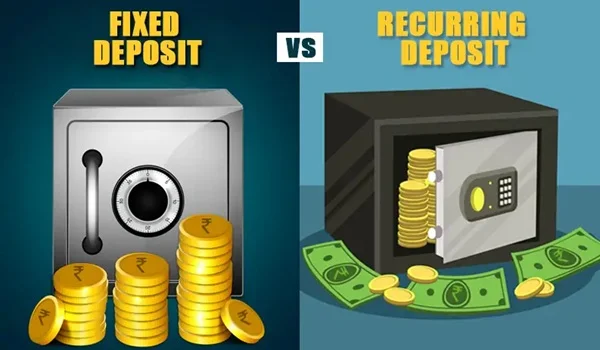
| Basis | Fixed Deposit (FD) | Recurring Deposit (RD) |
| Meaning | Lump-sum deposit for a fixed tenure | Regular deposits of a fixed amount |
| Investment pattern | One-time deposit | Periodic deposits, usually monthly |
| Suitable for | Existing surplus money | Regular monthly savings |
| Tenure | Fixed | Fixed |
| Interest | Based on deposit amount and tenure | Calculated on instalments as they are deposited |
| Liquidity | Lower than savings account | Lower than savings account |
| Premature closure | Usually subject to bank terms | Subject to bank terms |
| Monthly commitment | No | Yes |
| Maturity amount | Principal + interest | Total instalments + interest |
| Best suited for | Lump-sum investment | Goal-based regular saving |
The exact interest rates, tenures, minimum deposit amounts, premature withdrawal rules and other conditions vary between banks.
What Is a Fixed Deposit?
A Fixed Deposit is a bank deposit in which you invest a lump sum for a selected period at the applicable interest rate.
For example, suppose you have ₹3 lakh in surplus funds. You could place the amount in an FD for a chosen tenure instead of leaving the entire amount in a savings account.
Depending on the product, the interest may either be accumulated until maturity or paid periodically.
An FD is commonly considered by people who:
- Have a lump sum available
- Want a predetermined deposit tenure
- Prefer a bank-deposit product
- Want to earn interest on surplus money
- Are saving for a known future requirement
What Is a Recurring Deposit?
A Recurring Deposit allows you to deposit a predetermined amount at regular intervals, generally every month, for a fixed tenure.
For example, if you decide to save ₹10,000 every month for 24 months, you would make regular deposits into an RD according to the bank’s schedule.
The bank pays interest according to the applicable RD terms, and the principal plus interest becomes payable according to the product’s maturity rules.
An RD can be useful for people who receive regular income and want to save a fixed amount consistently.
Fixed Deposit vs Recurring Deposit: Key Differences
- Deposit Pattern
This is the most important difference.
In an FD, you generally deposit the entire principal amount at the beginning.
In an RD, you deposit smaller amounts periodically.
For example:
FD: ₹2,40,000 deposited once.
RD: ₹20,000 deposited every month for 12 months.
Although the total principal may eventually be similar, the interest calculation and maturity value will not necessarily be the same because the money remains deposited for different lengths of time.
- Who Can Use It?
Both FDs and RDs are commonly available to eligible individuals and may also be offered to other customer categories depending on the bank.
The more important question is how you receive and intend to save your money.
Someone with a large surplus may consider an FD, while someone who wants to save from monthly income may consider an RD.
- Interest Calculation
In an FD, the full principal is deposited from the beginning. Therefore, the entire amount generally earns interest according to the applicable FD terms for the selected tenure.
In an RD, each instalment is deposited at a different point in time. Therefore, the first instalment remains deposited longer than the last instalment.
This means an RD’s maturity amount cannot simply be calculated by applying the FD rate to the total of all instalments for the entire tenure.
- Investment Amount
FDs generally require a lump sum.
R
Ds require regular contributions.
This makes an RD potentially convenient for someone who does not have a large amount available today but can set aside a fixed amount from monthly income.
- Savings Discipline
An RD can encourage regular saving because you commit to depositing a predetermined amount at regular intervals.
An FD does not require monthly contributions because the entire amount is deposited at the beginning.
For someone trying to build a savings habit, the recurring nature of an RD can be useful.
Advantages of Fixed Deposits
Lump-Sum Investment
An FD allows you to put an existing surplus amount to work without making additional monthly deposits.
Predictable Interest
The interest rate applicable to the deposit is generally known when the FD is booked, subject to the bank’s terms.
Different Tenure Options
Banks typically offer multiple FD tenures, allowing customers to select a period based on their financial requirements.
Suitable for Surplus Funds
If you already have money that you do not need immediately, an FD may be considered as one of the deposit options.
Limitations of Fixed Deposits
An FD requires you to have the lump sum available upfront.
It can also have lower liquidity than a savings account. If you need to withdraw before maturity, the bank’s premature-closure rules may affect the interest payable.
Therefore, money that may be required for immediate emergencies should not automatically be committed to a long-term FD without considering liquidity.
Advantages of Recurring Deposits
Regular Saving
An RD allows you to save a fixed amount regularly instead of requiring a large lump sum.
Goal-Based Saving
It can be useful for planned expenses such as:
- Education expenses
- Annual fees
- A planned purchase
- Travel
- Festival expenses
- A future family requirement
Encourages Financial Discipline
Because a fixed instalment is scheduled regularly, an RD can encourage consistent saving.
Suitable for Monthly Income
People who receive a salary or regular income can set aside a fixed amount every month.
Limitations of Recurring Deposits
Regular Commitment
An RD requires you to make deposits according to the agreed schedule.
Missing an instalment may result in charges or other consequences depending on the bank’s terms.
Less Suitable for a Large Existing Surplus
If you already have a large amount available, an FD may be more directly suited to a lump-sum deposit than an RD.
Premature Closure Conditions
Early closure or withdrawal is subject to the bank’s applicable rules. The interest payable may differ from what would have been earned if the deposit continued until maturity.
FD vs RD: Example
Suppose Raj has ₹2,40,000 available today.
He could consider an FD by depositing ₹2,40,000 at once.
Now suppose Priya does not have ₹2,40,000 available, but she can save ₹20,000 every month.
She could consider an RD under which she deposits ₹20,000 each month for 12 months.
Both people may ultimately contribute ₹2,40,000, but their interest earnings will not necessarily be identical.
Why?
Because Raj’s entire ₹2,40,000 is deposited from the beginning, while Priya’s money enters the RD gradually.
The first RD instalment earns interest for longer than the final instalment.
FD vs RD: Which Gives More Interest?
There is no universal answer based only on the stated interest rate.
An FD and RD may have different applicable rates, and the principal is invested differently.
With an FD, the entire lump sum is present from the beginning.
With an RD, the principal builds gradually through instalments.
Therefore, when comparing the two, you should look at the actual maturity amount, not simply compare the headline interest rates.
The bank’s calculator or official deposit schedule can be used to determine the maturity amount for a particular deposit amount, tenure and interest rate.
FD vs RD: Taxation
Interest earned from both FDs and RDs can have tax implications.
The interest is generally taxable according to the applicable income-tax rules.
Banks may also deduct Tax Deducted at Source (TDS) when the prescribed conditions and thresholds are met.
Tax treatment and TDS thresholds can change, so depositors should check the applicable rules for the relevant financial year.
The tax treatment should also be considered when comparing the effective return from an FD or RD.
Fixed Deposit vs Recurring Deposit: Liquidity
Neither product is as flexible for everyday spending as a normal savings account.
FD
Premature closure may be permitted, subject to the bank’s terms. The applicable interest may be reduced or recalculated, and a penalty may apply depending on the product.
RD
Premature closure or withdrawal is also subject to the bank’s applicable rules. Some banks may impose conditions or charges.
Before opening either deposit, check:
- Premature withdrawal rules
- Applicable penalty
- Interest calculation on early closure
- Minimum tenure
- Maturity instructions
FD vs RD: Which Is Better for Monthly Saving?
An RD is specifically structured around regular contributions, making it useful when you want to save a fixed amount from your monthly income.
For example, someone earning a regular salary could set aside ₹5,000 or ₹10,000 every month toward a planned financial goal.
An FD, on the other hand, is more appropriate for a person who already has the money available and wants to deposit it as a lump sum.
FD vs RD: Which Is Better for a Lump Sum?
If you already have a lump sum and do not need the money immediately, an FD is generally the more directly relevant product to compare.
For example, if you receive a bonus, maturity proceeds from another investment or another lump-sum amount, you could compare FD rates and tenures offered by eligible banks.
FD vs RD for Different Financial Goals
| Financial situation | Deposit type to consider |
| Have a lump sum today | FD |
| Want to save monthly | RD |
| Received a large bonus | FD |
| Building a planned fund from salary | RD |
| Have surplus funds for a fixed period | FD |
| Want to develop a regular saving habit | RD |
| Need money immediately | Savings account may be more suitable |
This table is a general guide. Your actual choice should also consider liquidity, taxation, deposit tenure and the bank’s terms.
Can You Have Both an FD and RD?
Yes. They do not have to be alternatives.
For example, suppose you have ₹5 lakh in surplus funds and also want to save ₹15,000 every month.
You could consider an FD for an appropriate portion of the existing lump sum and an RD for regular monthly savings, depending on your financial goals and liquidity requirements.
Using both products can help address different savings requirements.
FD vs RD: Frequently Asked Questions
Is FD better than RD?
FD and RD serve different saving patterns. FD is designed for a lump-sum deposit, while RD is designed for regular periodic deposits.
Can I open an RD without a lump sum?
Yes. The purpose of an RD is to allow regular deposits rather than requiring the entire principal upfront, subject to the bank’s eligibility and product terms.
Which is better for salaried people?
An RD may be useful for someone who wants to save a fixed amount from monthly salary. However, a salaried person who already has a lump sum may also consider an FD.
Can I withdraw an RD before maturity?
This depends on the bank’s terms. Premature closure or withdrawal may be allowed subject to applicable conditions, interest adjustments or penalties.
Does an FD earn more than an RD?
The answer depends on the deposit amount, timing of deposits, tenure and applicable interest rates. Because FD and RD invest money differently, their maturity amounts should be compared rather than assuming one will always earn more.
Is RD interest taxable?
Yes. RD interest is generally subject to applicable income-tax rules. TDS may also apply when the prescribed conditions are met.
Conclusion
The difference between an FD and an RD mainly comes down to how you invest your money.
Choose an FD when you already have a lump sum and want to keep it deposited for a fixed period.
Consider an RD when you want to build savings gradually through regular deposits.
Before opening either account, compare the bank’s interest rate, tenure, minimum deposit, premature-closure rules, applicable charges, maturity amount and taxation. Most importantly, choose the deposit structure that matches the way your money becomes available—all at once or regularly over time.