A One Person Company (OPC) is a type of company structure in India that allows a single person to establish a company while enjoying the benefits of a separate legal entity and limited liability. It was introduced under the Companies Act, 2013 to provide individual entrepreneurs with a corporate business structure without requiring multiple shareholders.
An OPC can be useful for a person who wants greater legal separation between personal and business affairs while retaining control over the company. However, it also involves more statutory compliance than a sole proprietorship.
What Is a One Person Company?
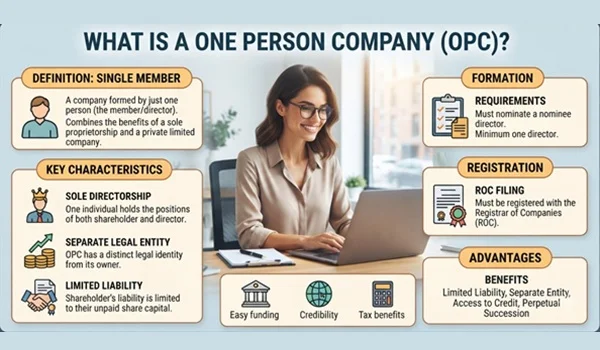
An OPC is a company that has only one member. The member holds the shares of the company and generally controls its affairs through the company’s management structure.
Unlike a sole proprietorship, an OPC is a separate legal entity. This means the company can own assets, enter into contracts and incur liabilities in its own name.
The OPC structure is governed by the Companies Act, 2013 and the rules made under it.
Key Features of an OPC
| Feature | Details |
| Minimum members | 1 member |
| Directors | At least 1 director |
| Separate legal entity | Yes |
| Liability | Generally limited to the member’s shareholding |
| Share capital | No prescribed minimum paid-up capital |
| Nominee | Nominee is required |
| Governing law | Companies Act, 2013 |
| Registration authority | Ministry of Corporate Affairs (MCA) |
Who Can Form an OPC?
An OPC can be incorporated by an individual who satisfies the eligibility requirements under the Companies Act and applicable rules.
An Indian citizen, whether resident in India or otherwise, may form an OPC subject to the applicable legal conditions. The rules governing OPC eligibility and residency have changed over time, so applicants should verify the current MCA requirements before incorporation.
An OPC also needs to nominate another eligible individual who can become the member of the company in the event of the original member’s death or incapacity.
OPC Registration Requirements
Before incorporating an OPC, the proposed member should generally arrange the following:
- One Member
Only one person is required as the member or shareholder.
- Nominee
The proposed member must nominate another individual in accordance with the Companies Act and applicable rules.
The nominee’s consent and prescribed documentation are required as part of the incorporation process.
- Director
An OPC must have at least one director. The sole member may also act as the director if eligible.
- Digital Signature Certificate
Since incorporation is completed electronically, the relevant individuals require a Digital Signature Certificate (DSC) for signing MCA forms.
- Director Identification Number
The proposed director needs a DIN or the applicable identification process through the MCA incorporation system.
- Registered Office
The OPC must have a registered office address in India for receiving official communications.
Documents Required for OPC Registration
Common documents required for incorporation include:
- PAN card of the proposed member
- Identity proof
- Address proof
- Passport-size photograph, where applicable
- Proof of registered office address
- Rent or lease agreement, if applicable
- Utility bill for the registered office
- No-objection certificate from the property owner, where applicable
- Nominee’s identity and address documents
- Nominee consent
- Digital Signature Certificate
- Details and declarations required in MCA forms
The exact documents can vary depending on the applicant and registered-office arrangements.
OPC Registration Process in India
OPC incorporation is completed electronically through the Ministry of Corporate Affairs (MCA).
Step 1: Obtain DSC
The proposed director or other person required to sign the incorporation documents should obtain a valid Digital Signature Certificate.
Step 2: Obtain DIN
The director must have a valid DIN. Where permitted, DIN can be applied for through the incorporation process.
Step 3: Select the Company Name
The proposed OPC name should comply with the naming provisions of the Companies Act.
The name should not be identical or too similar to an existing company or LLP and should not violate applicable trademark or other legal restrictions.
Step 4: Prepare Incorporation Documents
The applicant prepares the required incorporation documents, including details of:
- Proposed company name
- Registered office
- Member
- Director
- Nominee
- Share capital
- Main business activity
Step 5: File the Incorporation Application
The prescribed incorporation application is submitted through the MCA’s electronic system along with the required documents and declarations.
The applicable integrated incorporation process may cover various registrations and approvals associated with incorporation.
Step 6: MCA Verification
The Registrar examines the application and supporting documents.
If there are discrepancies or additional information is required, the applicant may need to respond or resubmit the relevant documents.
Step 7: Certificate of Incorporation
Once the application is approved, the Registrar issues the Certificate of Incorporation.
The OPC then becomes a registered company and receives its Corporate Identity Number (CIN).
Cost of OPC Registration
The total cost of incorporating an OPC is not necessarily the same for every applicant.
Costs can include:
| Cost Component | Details |
| MCA fees | Government filing fees as applicable |
| Stamp duty | Depends on the state and applicable documents |
| DSC | Digital signature cost |
| Professional fees | CA, CS, lawyer or consultant charges, if used |
| Other registrations | GST or other registrations where applicable |
Government fees can depend on factors such as the company’s authorised capital and the applicable filing requirements.
Therefore, the exact amount should be checked on the MCA portal before incorporation.
Benefits of an OPC
- Separate Legal Identity
An OPC is legally separate from its member. The company can own assets, enter into contracts and conduct business in its own name.
- Limited Liability
The member’s liability is generally limited to the amount invested in the company, subject to applicable law and exceptions.
This provides a greater separation between personal and business liabilities than a traditional sole proprietorship.
- Single Ownership
The individual does not need to find a second shareholder merely to establish the company.
This allows the owner to retain control over the business while operating through a corporate structure.
- Perpetual Succession
The nominee mechanism provides a framework for continuity in the event of the member’s death or incapacity, subject to the applicable legal process.
- Corporate Credibility
An OPC has a formal corporate structure, which may be useful when dealing with customers, vendors, financial institutions and other businesses.
Limitations of an OPC
An OPC also has several limitations that should be considered before incorporation.
- Only One Member
An OPC is designed for a single-member ownership structure. A person who wants multiple shareholders must use another structure, such as a private limited company.
- Restrictions on Certain Activities
The Companies Act and applicable rules prescribe restrictions regarding the activities that an OPC can undertake.
Applicants should verify the current eligibility requirements before choosing the structure for a particular business.
- Compliance Requirements
An OPC has more formal compliance obligations than a proprietorship.
Depending on the company’s circumstances, it may need to maintain statutory records, prepare financial statements and complete MCA and tax filings.
- Limited Fundraising Through Equity
An OPC cannot operate like a conventional multi-member company with multiple shareholders. If the business intends to raise equity from investors, conversion into another company structure may become necessary.
- Conversion Requirements
If the business grows and the owner wants additional shareholders, the OPC may need to be converted into a private or public company as permitted under applicable law.
OPC vs Sole Proprietorship
| Basis | OPC | Sole Proprietorship |
| Owner | 1 member | 1 proprietor |
| Separate legal entity | Yes | No |
| Liability | Generally limited | Generally unlimited |
| Registration | MCA incorporation required | No single central incorporation |
| Compliance | Higher | Generally lower |
| Ownership transfer | Subject to company law | Comparatively simple business transfer arrangements |
| Suitable for | Individual seeking corporate structure | Small or low-risk individual businesses |
OPC vs Private Limited Company
| Basis | OPC | Private Limited Company |
| Minimum members | 1 | 2 |
| Separate legal entity | Yes | Yes |
| Shareholders | One | Two or more |
| Directors | At least 1 | At least 2 |
| Equity fundraising | More limited | More suitable |
| Compliance | Generally lower than a larger company structure | Generally more extensive |
| Suitable for | Single-owner businesses | Businesses with multiple owners/investors |
Compliance After OPC Registration
Registration is only the beginning of the company’s legal obligations. An OPC must comply with applicable provisions of company law and tax laws.
Depending on the company’s circumstances, compliance may include:
- Maintaining books of account
- Preparing financial statements
- Filing annual financial statements
- Filing annual return
- Income-tax return
- GST returns, where applicable
- TDS compliance, where applicable
- Maintaining statutory registers and records
- Updating MCA records when company details change
The specific compliance requirements depend on factors such as turnover, business activity and applicable exemptions.
When Should You Consider an OPC?
An OPC may be considered by an entrepreneur who:
- Wants to operate alone
- Wants a separate legal entity
- Wants limited liability protection
- Wants a formal corporate structure
- Does not currently require multiple shareholders
- Is prepared to meet company-law compliance requirements
A sole proprietorship may be simpler for a very small business, while a private limited company may be more appropriate where multiple owners or outside equity investors are expected.
Conclusion
A One Person Company (OPC) provides a middle ground between a sole proprietorship and a conventional private limited company. It allows one individual to establish a separate legal entity while generally benefiting from limited liability.
The registration process involves choosing a compliant company name, arranging a registered office, appointing a director and nominee, obtaining the necessary digital signatures and identification details, and filing the incorporation application with the MCA.
The main benefits of an OPC include single ownership, separate legal identity and limited liability. Its limitations include higher compliance than a proprietorship, restrictions applicable to OPCs and the practical challenges of bringing in additional equity owners.
Before choosing an OPC, an entrepreneur should consider the nature of the business, liability exposure, expected growth, funding plans and ongoing compliane obligations.